
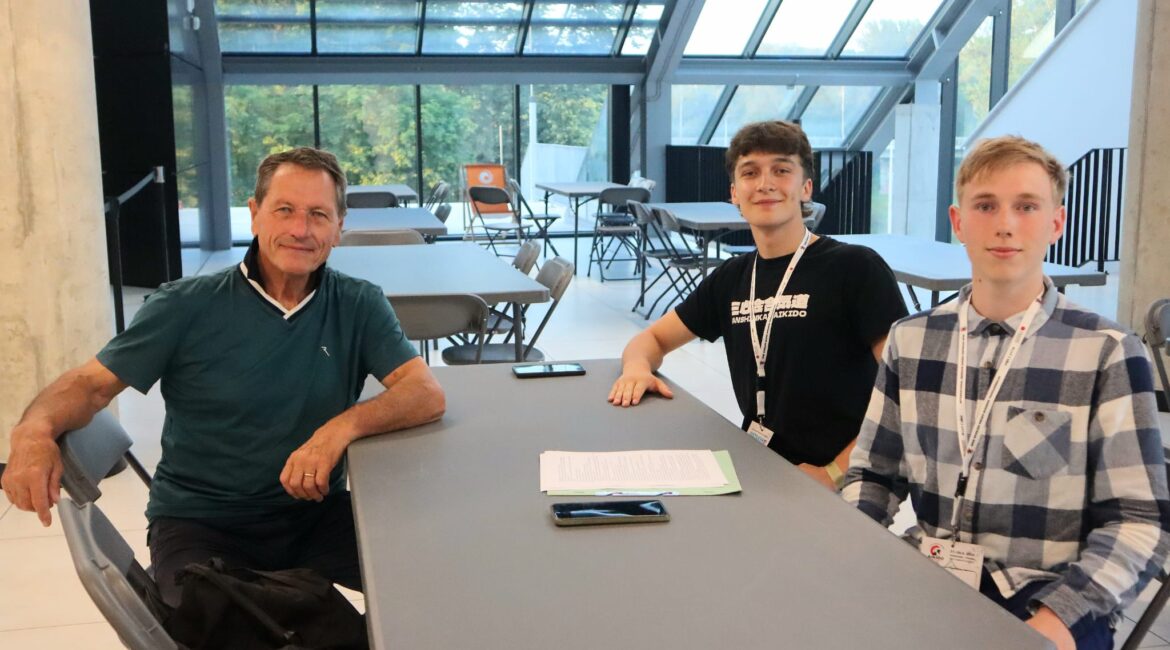
This interview took place during an aikido seminar in Ostrava, led by Tissier Sensei and Kanazawa Sensei. The event was organized by The Czech-Japanese Cultural Center (websites). The interview was conducted by Ladislav Kořan, with on-site interpretation and subsequent editing by Tomáš Suchan


Who was your first Aikido teacher? What influence did he have on you?
Christian Tissier: It was Jean-Claude Tavernier. He was about 15 years older than me when I met him. He helped me a lot to connect with adults (I was 11 years old, still a kid). Thanks to him, I met Nakazono Sensei. He was a Japanese teacher, very good at Judo and Karate, 6th dan in Aikido. Of course, at that time, 6th dan was a very high level. I continued to study with Nakazono Sensei for four years in Paris until I left for Japan when I was 18 years old.
Nakazono Sensei thoroughly studied Kotodama. Did you get to study Kotodama with him?
Well, Nakazono Sensei was very involved in spiritual activities, Shiatsu and also Kotodama. He didn’t learn those directly from Ogasawara Sensei, although they were in contact with each other. He would sometimes explain Kotodama while he was teaching Aikido. He would talk about the theory of sound, and that kind of stuff. Not too much, but little by little more and more. I was 15, 16, 17, so I was very impressed. But it was difficult for me. Well, not only for me, but for everybody because it was not very clear. Later, when I was in Japan, I tried to understand what Kotodama really means. The problem with it is that it’s not something concrete. It’s a theory, a special theory. There are some very good and fine, but also strange concepts involved.
Do you know if Nakazono Sensei learned Kotodama directly from O-sensei?
No, not at all. Nakazono was a specialist in Kotodama; O-sensei wasn’t. O-sensei was interested in it, in Shinto, but he never taught it in depth.
Nakazono Sensei reportedly wrote a letter to Yamaguchi Sensei before you flew to Japan. Was it a recommendation letter?
Yes. Nakazono was a close friend of Yamaguchi and Nishio Sensei.
It was soon after the Founder’s death when you arrived at Hombu. What was the mood there?
The Founder passed away a few months before I arrived. Because O-sensei passed away, of course, problems in Aikikai appeared. Some of the most advanced teachers wanted to become the Doshu, the head of Aikido – for example, Tohei Sensei, the chief instructor of Hombu, and also Saito Sensei. He was watching over the shrines in Iwama. In the end, the teachers decided to accept Kisshomaru (Ueshiba) as the Doshu. Tohei Sensei left one year after I arrived. He founded his own school, Ki no Kenkyukai.
Well, the mood in Japan was different after O-sensei’s death. All the teachers and young people wanted to preserve Aikido. Maybe that was why they did more. It was quite tough. The practice was harsh at that time. It’s a bit different now because today Aikido is spread all around the world. In Hombu Dojo, it’s still very technical, however they don’t want to risk injuries anymore. The practice feels a bit different. I would say it’s more friendly now.
Who were the Uchi-deshi at the time?
A generation of Uchi-deshi had just ended their intensive study – Endo Sensei, Suganuma, Ichihashi, and Saotome. I think Endo and Suganuma just got their 5th dan. The new Uchi-deshi, my generation, were Shibata, Seki, Yasuno, Ishigaki, and Miyamoto, a little bit later. After I left Japan came Yokota and others.
You became “Dojo no Kanji”. What did it involve?
With Masuda Sensei and two other Japanese guys, we became Dojo no Kanji, executive members of the Dojo. We had a tag on our Keikogi. Anybody could ask us for anything, and we would take care of it. I was also watching over the foreigners, although there were not so many at the Hombu then. I was their chief until I left Japan.
I heard that you practiced Kashima Shin-ryu with Inaba Sensei. Where did you do so?
Inaba Sensei was a student of Yamaguchi Sensei, and so I already knew him. He studied Kashima Shin-ryu with Kunii Sensei, who was a Soke, for about one year, year and a half. He learned a lot. Unfortunately, Kunii Sensei passed away. Inaba wanted to continue to practice what he had learned with him. I talked to him, and he said, “Okay, if you want, we can practice together.” I kind of looked up to him as my teacher, because I was 20 years old, and he was about 30.
When I first met Inaba, he worked as a policeman. Later, he left the police force and became a journalist for the Shinto Journal. The Shinto Journal resided in a very important building. On top of the building, there was a big hall for ceremonies, a Tatami hall. That’s where we would train five to six hours every Sunday morning. There were only three or four of us. I recall that Yasuno Sensei was there. We would start with Kesagiri – three thousand, five thousand Kesagiri. That takes approximately three hours. After that, we would learn Kata with Inaba Sensei.
After about two years, they built a Dojo for Aikido, Kyudo, and Kendo in Meiji Jingu Temple, the main park. You know, that’s Shinto. Shinto has a lot of money. They asked Tanaka Sensei to become the chief responsible for Shiseikan. We moved there with Inaba Sensei, who was asked to teach at the venue. By the way, my membership number in Shiseikan is seven. And so we continued to practice. I was not practicing much Aikido at that time, because I was training Kenjutsu two, three times a week. Every day, I would practice Kesagiri.
Now, let’s move to the present day. I heard the French government wants to unify the two local Aikido federations. How is it going, and what does it mean for them?
It’s going well. We are required to merge together before 2030, but we intend to be together in 2028. In some way, the techniques are a little bit different, but for me, that’s not a problem. When I was in Hombu Dojo, I would practice with everybody. I can see what is correct, even if it looks different. A dancer, or even a musician, can also tell what is correct when looking at Aikido, even though they never studied it.
Some people practice only under Tamura Sensei. Don’t get me wrong, I also practiced with Tamura Sensei a lot, and it was very nice. We had a very good relationship together. The problem is that some of his students are a little bit… I mean, for them, there is only Tamura, and nobody else. Now that’s changing a bit. Why? Because many people from their federation go to Japan, or they visit a different Sensei, and they see something new.
My Aikido differs from the Aikido of Kanazawa Sensei, Yasuno Sensei, or Endo Sensei, but the principles stay the same. When I see Kanazawa Sensei doing Shihonage, Ikkyo, or Iriminage, I can see it’s perfect. Do you understand? Basically, everything is correct, but the shape, the form, might look different. Also, the interpretation can be different. If we make some basic Shomenuchi Ikkyo, we could do the same as Doshu. But apart from that, you also have Yamaguchi, and so on. Everybody has their own. They keep the principles, but the technique changes. For some people, it’s difficult to understand that. They think, “If it’s not what I usually do, it’s not good.” No, that’s a wrong approach.
I think we are on a good path now, because the new president (of the FFAB), Didier Allouis, is very honest. I’ve known him for a long, long time. The beginning will be difficult. We’ll have to separate examination. Before we fully merge, there will be many, many problems. With most people, there is no problem, but with some, it is very hard to find common ground. They don’t want to talk too much.
The attitude is good, the technique is correct, the relation is okay – that’s a big hope. It’s very important for French Aikido to unite, because when you have two separate federations, you spend more money on publicity as you fight over influence. United, we will have more money to promote Aikido, more power to promote it. That will be great, especially now, since Aikidokas are going a little bit down in numbers. We need to show a good face of Aikido; otherwise, it’s going to be very difficult in the future.
You see, this is not my issue. I’m 75. I don’t know what’s going to happen in two, three, four, or five years. It’s not for me to deal with this. It’s for the young generation.
Which way do you think Aikido should head in today’s world? What should the teachers focus on?
I think that Aikido is specific in some sort of way. In Judo, you have Shiai, competitions, and even the Olympics. That changes a lot of things. In Karate or Taekwondo, there is also a championship. People doing classic Karate sometimes participate in competitions, and sometimes not. It is interesting that in Japan, the Kata champion is usually also the best fighter. In Europe, the champion in Kata is never. Europe lost a little bit. The Kata in Karate are very strict, but the competition is a little bit too sporty. It’s much more physical, different from what it meant to be. In Aikido, there is no competition. That’s our first specificity.
Today, it’s crazy to say, “I learn Aikido because I want to be stronger.” It’s like that because now you have MMA. Would you like to do MMA? Okay, I respect it. But do you want to punch someone? We should work on our specificity. Aikido is a martial art. So what is a martial art? Well, you learn how to preserve yourself, but not only in a fight – it’s the way you behave, the way you understand things. That’s Budo. Budo is the way to educate yourself. You want the right attitude at the right moment – communication. What kind of communication? Sometimes you have to cut, enter, and sometimes not. In your techniques, you are looking for a pure gesture. Your partner is going to give you a small problem. You have to solve it with the purest gesture, the best possible way. If your Aikido contains a pure gesture, even if your partner doesn’t want to cooperate, in your mind, you will adapt your attitude. That’s what we look for. That’s the second specificity of Aikido.
It’s crazy to say, “My Ikkyo is wrong.” If it’s correct, pure, beautiful, or if you do it technically, that will work enough. The purpose is not to pin somebody, do you get it? The purpose is to educate yourself. People doing Kyudo, Japanese traditional archery, don’t do it because they want to kill rabbits. Do you understand? It’s because they want to achieve a pure gesture. Aikido should preserve its specificity.
On the other hand, we have to think about Aikido for young people. That’s why we also need dynamic Aikido. We shouldn’t talk too much about philosophy. If you have a question, sure, I can answer, but if you come to my place, to my Dojo, we practice. I will not tell you, Aikido is this or that – no, no, nothing of that. After the lesson, if you have a question, maybe I can give you an answer, but I am not a philosophy teacher. We’ve had a lot of those in our culture – Socrates, Aristotle – just too many.
What does Takemusu Aiki mean to you?
Well, it depends on what we are talking about. I have a huge respect for Takemusu and the techniques of Musubi and everything. When Saito Sensei was teaching at Hombu, he led a class every Sunday morning. For two years, I went there to practice. It was very, very interesting, really. But like I said before, for some people today, you know, it’s Saito Sensei and nothing else. That’s the problem. The technique is pure, but when you get to discovering your own specificity, you are more and more closed, you know. That’s how I feel. That’s why it’s very important to stay open-minded, yes.
Do you know Patricia Hendricks? When I go to San Francisco, she’s always coming, always. I mean, even though she wrote a book about Aikido, she still wants to learn something new, different. It’s very interesting when people embrace the differences.
To top it off, what do you think is the most important thing in life?
In life? I think that would be fidelity, to be faithful. Yes, to have faith in your friends and in your teachers. Fidelity is very important. Fidelity and sincerity.
Thank you very much for your time, Sensei! That’s everything.