
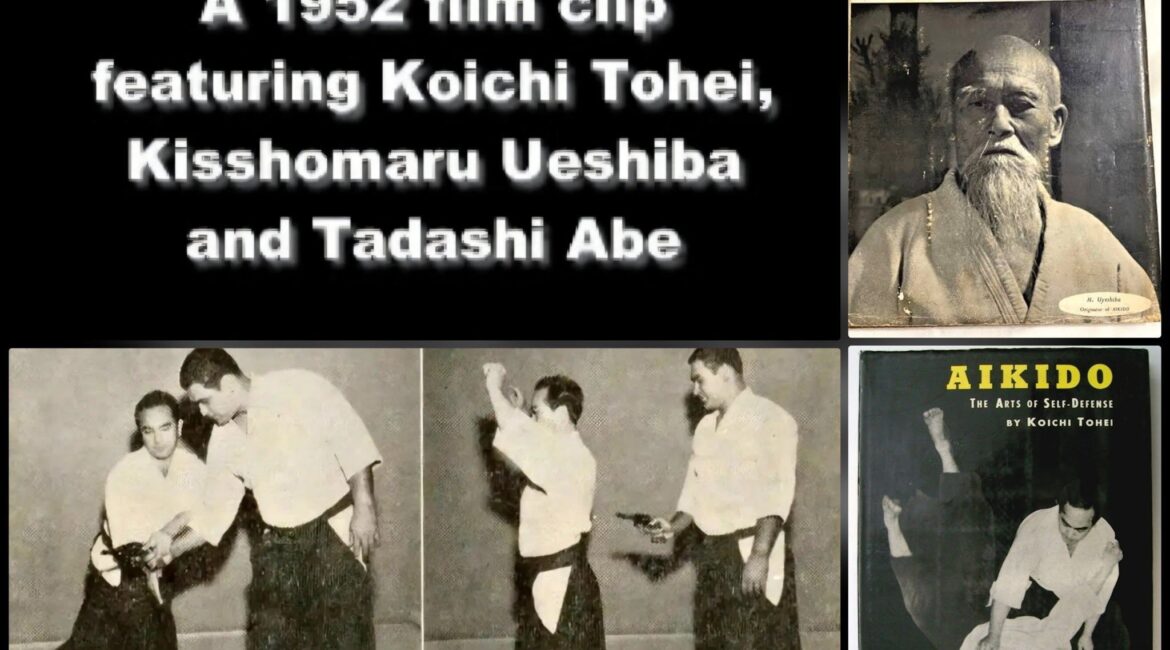
Reposted from the Aikido Sangenkai Facebook page with the kind permission of Christopher Li Sensei. This article is part of the “Exploring Historical Photos” series, produced in collaboration between Aiki-wiki and Aikido Sangenkai.
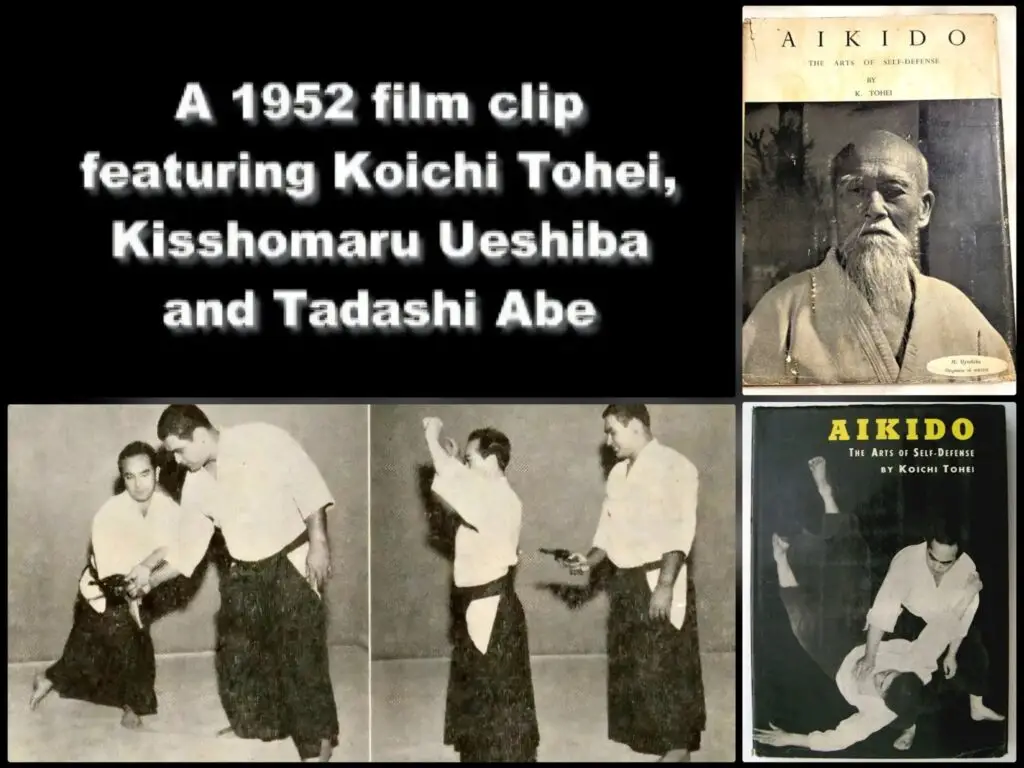
It’s become more common In recent years to respond to questions of Aikido’s effectiveness with the assertion that it was never intended to be effective, or to be applied in live self-defense situations.
Unfortunately, this is a kind of “sour grapes” response that relies on an appeal to the authority of an erroneous historical narrative.
For example, here’s an interesting video, filmed in 1952, that features Kisshomaru Ueshiba, Koichi Tohei, and Tadashi Abe in street clothes – it was created by the Aikikai in order to market Aikido as an effective means of self-defense:
Further, several of the official publications issued by the Aikikai, while Morihei Ueshiba was alive, prominently featured “Self-Defense” in the title.
Here is an extract from one of those:
“The art of self-defense must be one that can be used in a real fight. You need not use the art against someone who hits you in fun, But if your opponent wants to make it a no-holds-barred scrap, it will be he who decides how he should attack you and you cannot call foul at anything he does…In Aikido, you practice always to adapt yourself to real fights.”
“Aikido, the Coordination of Mind and Body for Self Defense”
Authored by Aikido Hombu Dojo Chief Instructor Koichi Tohei, edited by Morihei Ueshiba – 1961
Morihei Ueshiba himself, of course, continued to instruct the police and the military after the war, and his student Hiroshi Isoyama instructed the American military police:
“They didn’t believe that Aikido works…I made them believe”
After the war, Morihei Ueshiba would often travel around Japan – and instructed his students that while he was away “Never refuse a challenge!” – challenges were still common in the post-war period, many of them handled in Tokyo by Kazuo Chiba.
Shoji Nishio also had some thoughts about developing Aikido’s effectiveness as compared to other martial arts:
“That’s why most people’s practice today is empty. They don’t look at other types of Budo. Right from the start, the value of a Budo is determined by comparisons with other Budo.For the most part, if you set up Kokyu-ho between two Aikido people it’s just useless. That will only be effective in the dojo. I guess that those people say things like “Even though you do Aikido you’re also doing Karate and sword. If you want to do Karate then go to Karate. If you want to do the sword then go to Kendo. If you’re doing Aikido you don’t need to do other things.”. Even in other Budo, everybody is working hard, you know. When we see that we should make an effort to surpass them with our Aiki. That is the mission of Aikido as a Budo.”
“Interview with Aikido Shihan Shoji Nishio”
https://www.aikidosangenkai.org/blog/interview-aikido-shoji-nishio/
Kisshomaru Ueshiba himself summed it up here:
“However much it is said that Aikido does not concern itself with winning or losing, as it is Budo it goes without saying that it must be useful for self-defense.”
– Kisshomaru Ueshiba, “Subarashii Aikido”, 1994
Now, there’s absolutely nothing wrong with practicing Aikido, or anything else, without any interest in live physical application. More than 100,000 people study Kyudo in Japan alone – likely more than Aikido, and that has exactly zero real world applicability.
But let’s leave out the historical revisionism.