

We are publishing this article with the kind permission of Susan Perry, Ph.D., Editor-in-Chief of Aikido Today Magazine. Aiki-wiki and Aikido Today Magazine are now collaborating to preserve and digitise old articles.
Susan Perry Sensei’s personal website: https://susanperry.info/
All issues of Aikido Today Magazine can be purchased here: https://budovideos.com/products/aikido-today-magazine-e-book
by Beth Shibata — Aikido Today, Spring 1988, Vol. 2, No. 1
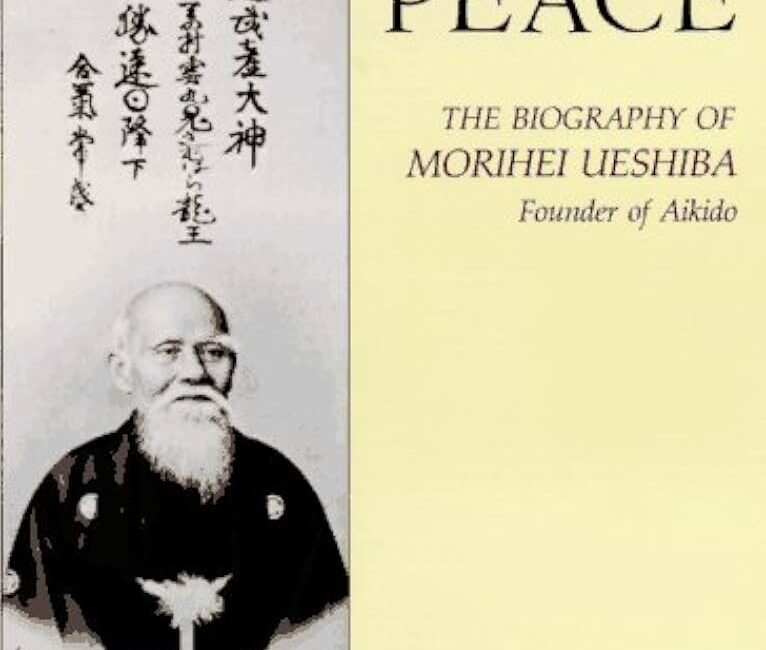
Abundant Peace, by John Stevens, Shambhala Publications, 1987.
There is always difficulty in writing the biography of an exceptional person whose exploits and abilities beggar belief. The founder of Aikido, Morihei Ueshiba, was such a person. The stories of his physical feats and of the seemingly magical feats of his later years are already legendary. This makes telling his life-story a formidable task. And the task is even more difficult because so many people who knew O’sensei are still living — from his son, the current Doshu Kisshomaru Ueshiba, to live-in students, to contemporaries.
Biographer John Stevens does an admirable job of sorting out the various tales by providing a good deal of information in an historical context. And, as I read Abundant Peace, I sensed Stevens’s earnest desire to make O’sensei understandable and accessible to a Western audience largely unfamiliar with the more arcane aspects of Japanese spirituality that form the foundation of Aikido.
A number of O’sensei’s abilities bordered on the unbelievable, particularly his strength and his sixth sense. Stevens, however, does not dwell on these topics. Instead, he encourages the reader to look at O’sensei as a gifted and unique person who spent his life searching for something beyond the mundane — someone who blended the spiritual and physical into a transcendent form.
Because he urges us to view O’sensei in this way, it is easier to forgive the occasional shifts Stevens makes from the objective coolness of a historian to a warmer, more affectionate tone, like the one in which people discuss favorite, eccentric uncles.
Abundant Peace, whose title is taken from the translation of O’sensei’s first name, is organized in three sections — The Man, The Martial Artist, and The Message. Each section deals with a major component of O’sensei’s uniqueness. The thread that holds them together is O’sensei’s spiritual and mystical beliefs, the faith in a greater truth, which led him to and helped him along a difficult but rewarding path.
In the first part, Stevens chronicles many stories — stories about O’sensei’s illness as a child, about his pursuit of martial arts as a young man, and about his feats of strength in his early adult life. The stories are offered here with the addition of the context in which they occurred, although the author acknowledges those areas where little information exists. And Stevens’ telling is not limited to the difficulties that O’sensei himself faced; the hardships his family endured are chronicled as well.
The second part, which covers O’sensei’s training in the martial arts, reveals the roots and sources from which Aikido was eventually born. Stevens discusses the many influences on O’sensei: sumo, aiki jutsu, sword styles, staff styles, and the universals of ki and kokyu (breathing). He also traces the changes the core of Aikido underwent through the 40 years that O’sensei spent refining his art. And his translations of a number of O’sensei’s doka (short poems) may provide food for thought for those trying to understand particular movements.
In the third part, Stevens provides a concise summary of the basic concepts of Aikido. The triangle, square, and circle — concepts frequently applied to body movements — are given their metaphysical significance in Aikido. The metaphysical aspects may seem odd to a reader more comfortable with logical and rational frameworks, but they show how closely knit the spiritual and physical were for O’sensei. Here, in “The Message”, there seems to be a plea to the Aikido community to truly pay attention to O’sensei’s teachings. For as Aikido developed a following and the number of instructors grew, so did the discord, much to O’sensei’s dismay. The lessons Aikido teaches seems not to have gone far enough.
You can find this entire article and much more in Aikido Today Magazine.
Aikido Today Magazine
Aikido Today Magazine was a forum where Aikido students and teachers wrote in their thoughts. Many were the controversies about the nature of Aikido and how it should be practiced. Many articles from the beginner point of view as well as articles and interviews with seasoned teachers. ATM enjoyed correspondents from all over the world. Don’t miss out on this great material.
You can find this entire article and much more at: https://budovideos.com/products/aikido-today-magazine-e-book
More from the author of Aikido Today Magazine
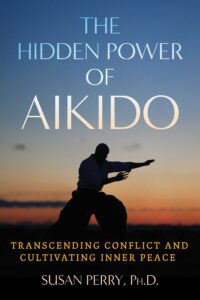
Illuminating the inner philosophical and practical aspects of Aikido, forty-seven-year Aikido practitioner and 6th-degree blackbelt Susan Perry, Ph.D., uses personal stories of joy, achievement, and hardship to demonstrate real-life applications of the transformational principles of Aikido. She introduces what Aikido is and where it comes from, providing a brief biography of its founder, Morihei Ueshiba. She explains in detail how Aikido helped her resolve difficulties at work, as a student, and as a teacher/sensei. Through each story shared, the author offers a glimpse of the beginner’s mind in action, the key to changing even the violent energy of an attack into peaceful interaction.
Presenting Aikido’s step-by-step protocol for developing the receptiveness of the beginner’s mind, a state essential to personal transformation, Perry explains how distraction and timing can be used to deescalate potentially violent or dangerous situations. She discusses the founder’s philosophy of conflict, showing how Aikido can help peacefully resolve difficulties that arise with pushy, intimidating, and unpredictable people, those who are stubborn or don’t listen, insincere people who want something from you, and chaotic situations. She explains how a deepening practice of the martial art leads to an aiki state of inner peace, fusion, and boundless joy.
Revealing how Aikido can help you face your fears and develop your heart and soul, this book shows how this martial art helps you embrace change, cultivate a strong center, and ultimately live a joyful life of engagement with the world.
You can buy the book here: https://www.amazon.com/Hidden-Power-Aikido-Transcending-Cultivating/dp/1644118971
Budo Videos

Budo Videos is a very extensive online shop specialising in budo. It features a wealth of fantastic content, and you’ll find plenty of material from Susan Peryy, editor-in-chief of Aikido Today Magazine.
If you’re interested in Japanese budo, Budo Videos is one of the best shops specialising in this subject. There’s also plenty of material here for Aikido practitioners that you’d struggle to find elsewhere.
Link: https://budovideos.com/

