Mr Rubin is Professor of the History of Ideas at Pitzer College and a chief instructor of The Claremont Colleges Aikido Club, which is an affiliate of Seidokan.
In addition to technique, O-sensei’s legacy includes a great many words — sayings, short verses, and lectures on philosophical and religious topics. Should these words figure into the practice of Aikido, now in America? And, if so, how?
One view, perhaps more often held than expressed, is that O-sensei’s writings are simply the ravings of a loony Omoto mystic. Another is that the writings, though perhaps valuable in some ways, do not have any direct bearing on Aikido practice. Still another view is that, while the writings may be difficult to translate and interpret, our study of Aikido is incomplete unless we study them, discover their lessons, and apply those lessons to our practice.
In one of his lectures (quoted in Saotome Sensei’s Aikido and the Harmony of Nature, p. 152), O-sensei explains his own views on the importance of words to Aikido. The lecture begins with the thought that, in addition to training our bodies and our ki, we should also “train our minds to harmonize with the movement of the universe.” And he then adds this:
If your mind is to be in harmony with the universe, your words must also be in harmony with the universe….Then the movements of the physical body, your actions, must be in harmony with those words. This is the secret taught to me by Budo [italics mine].
What exactly does this mean? Let me be the first to say that I don’t really know. It probably has some deep connection with kotodama, a metaphysical system of sounds that O-sensei found in the Omoto religion and adapted to Aikido. (See, e.g, John Stevens’ Abundant Peace, pp. 102-105). Strange as it may seem, O-sensei’s point seems also to have something to do with the New Testament verse, “In the beginning was the word…and the word was God” [John 1,1]. (He himself draws the connection in untranslated portions of the interview with Lee Green on Aiki News tape #7.)
But, whatever exactly the metaphysical and religious meaning of O-sensei’s lecture, one point is clear: According to O-sensei, budo’s innermost lesson is bound up, not just with our bodies and spirits (ki), but also somehow with our intellects — our thoughts and words.
An example of an American Aikidoist who takes this thought to heart is Rod Kobayashi Sensei. After 24 years of association with World Headquarters and the Ki Society, Kobayashi founded his own organization in 1981, capturing O-sensei’s idea of budo’s lesson in its name: Seidokan.
The first character of this name is pronounced “sei” in compounds but “makoto” when it appears alone. And this character is a combination of two others: one whose meaning has to do with speech, and one whose meaning has to do with something’s succeeding, coming true, or becoming actual. Thus, the whole character signifies a statement’s coming true, a thought’s manifesting itself in an action, or, as O-sensei put it, “a movement of the physical body harmonizing with words.”
The problem, of course, is figuring out how actions can harmonize with words. What does this mean in practice?
One kind of application seems obvious. Most, if not all of us, have practiced with partners who talk better Aikido than they do — people who, say, give instruction on throws that they themselves cannot perform. What makoto requires is, not that these people abandon words and simply train their bodies, but that they remember the words and strive to make their actions conform to them. According to Kobayashi sensei, this attempt to unite words with action produces earnest, realistic, and sincere practice.
Of course, when we try to make our movements conform to our words, we should choose our words very carefully. (Hence, O-sensei’s insistence that, before we bring our movements in line with our words, we bring our words into line with the universe.) Accordingly, the words around which Kobayashi structures his practices are often O-sensei’s own doka — short verses in which O-sensei attempted to capture essential instruction.
An example [in Kobayashi’s translation] is this:
Let your right hand be visible, yang
Your left hand leads the enemy inconspicuously, yin.
How can we harmonize the movements of our bodies with these verses?
Kobayashi illustrates the answer with staff (jo) technique. When a person stands with one foot forward and points a jo towards an opponent’s chest or throat, one of the person’s hands is clearly visible to the opponent, while the other is “hidden”. The lesson of O-sensei’s doka, explains Kobayashi, is that the hidden (yin) hand should control the weapon rather than the visible (yang) hand. “It is the hand that holds the end of the handle [of a ken or jo],” says Kobayashi, “which transfers ki to the weapon.”
An easily noticeable consequence of accepting this advice is that control of the weapon passes from the muscles of the forward arm and shoulder to the more powerful muscles of the torso. Another, which may be closer to the point of O-sensei’s poem, is that one gains the ability to “fool the opponent’s body.” Expecting to meet strong resistance from the hand extended towards him, a person who, say, grabs an opponent’s jo, can be easily controlled by the “inconspicuous” rear hand.
The same point applies to many versions of the tenchinage throw. The thrower’s clearly visible (yang) hand comes up in front of the opponent’s face, drawing his attention and “leading” his mind. But, as the technique is often interpreted, it’s the hidden (yin) hand that unbalances uke and causes the fall.
Arising directly from O-sensei’s verses, Kobayashi’s suggestions about which hand should be in control provide a small but concrete example of how O-sensei’s writings bear on Aikido technique. Other writings offer other lessons. While these writings haven’t been systematically collected, edited, and translated into English, some can be found fairly easily — for example, in Saotome’s Aikido and the Harmony of Nature, Stevens’ Abundant Peace, and Kisshomaru Ueshiba’s The Spirit of Aikido.


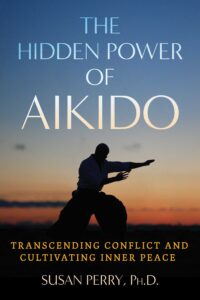 Illuminating the inner philosophical and practical aspects of Aikido, forty-seven-year Aikido practitioner and 6th-degree blackbelt Susan Perry, Ph.D., uses personal stories of joy, achievement, and hardship to demonstrate real-life applications of the transformational principles of Aikido. She introduces what Aikido is and where it comes from, providing a brief biography of its founder, Morihei Ueshiba. She explains in detail how Aikido helped her resolve difficulties at work, as a student, and as a teacher/sensei. Through each story shared, the author offers a glimpse of the beginner’s mind in action, the key to changing even the violent energy of an attack into peaceful interaction.
 Budo Videos is a very extensive online shop specialising in budo. It features a wealth of fantastic content, and you’ll find plenty of material from Susan Peryy, editor-in-chief of Aikido Today Magazine.