

We are publishing this article with the kind permission of Susan Perry, Ph.D., Editor-in-Chief of Aikido Today Magazine. Aiki-wiki and Aikido Today Magazine are now collaborating to preserve and digitise old articles.
Susan Perry Sensei’s personal website: https://susanperry.info/
All issues of Aikido Today Magazine can be purchased here: https://budovideos.com/products/aikido-today-magazine-e-book
Aikido Today, October 1987, Vol. 1, No. 3
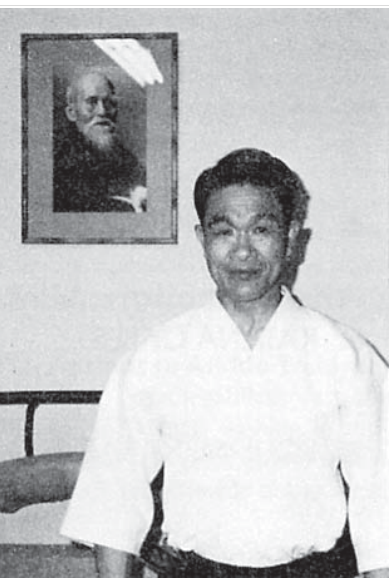
In addition to holding the rank of 8th dan in Aikido, Shoji Nishio Sensei has earned 5th dan rankings in both Judo and Karate and master-level ranks in arts of the sword, spear, and staff.
On a recent visit to Los Angeles, Nishio Sensei graciously allowed us to tape his answers to several questions. Some of those answers appear below, translated from the Japanese by Chikako Higa and Darren McKee.
AT: What is Takemusu Aiki?
Nishio: Originally, true budo was supposed to open peoples’ way of life and bring happiness. Unfortunately, about a thousand years ago, people reversed budo’s direction, using it in fighting and competition. Aikido exists in order to demonstrate that such budo is wrong—to open our way of life and bring happiness… [In written Japanese, the ‘bu’ in ‘budo’ is the same character as the ‘take’ in ‘takemusu’—ed.]
I feel sorry for Japanese budo in the U.S., since many American budoka don’t understand real budo. To tell the truth, very few Japanese budoka in the U.S.A.—including Aikidoka—are at the highest level of their arts; they are on the second or third levels down. I’m saying this so there will be no mistake about it.
A budoka who understands true budo teaches how ridiculous it is to hurt people. There is nothing easier than hurting people and knocking them down, awful things to do. But Japanese budo, such as Judo, Karate, and Kendo, have spread all over the world in the wrong way. Aikido must therefore demonstrate that this way of budo is wrong—that to win is not to hurt people and that only inferior people injure others.
If one masters just one part of budo—such as Judo, Karate, Kendo, Yari, or Bo—that does not signify mastery of budo. Since budo is no one of these arts, mastering one art has little importance. Among human beings, some are male and some female. Females do not by themselves make up a species; if there were only females, humanity would be crippled. The same thought applies to budo. Judo alone does not constitute budo; Karate alone does not constitute budo; and Kendo alone does not constitute budo. If one’s art has only one of these, it is crippled.
We, as Aikidoka, must let people know that Judo, Karate, and Kendo lack many things. We must also let them know that budo’s aim is, not to knock people down, but to broaden our view of others and to open our minds. When we do open our minds, there will be no point to discussing racial, national, or religious differences. The aim of Takemusu Aikido is to develop respect and love in peoples’ hearts—to demonstrate the unity of all mankind.
AT: When did you start your training in budo?
Nishio: Weak when I was young, I started studying Judo when I was 16, and it made me stronger. Right after receiving my fourth dan in Judo, I broke my shoulder and decided to start studying Karate. Still, I had some doubts about Judo and Karate. At the time, many of my friends were Judo and Karate champions, but they were not at the level at which I expected them to be. I felt that there must be more to budo—that it must be deeper than that.
Just when I was becoming disappointed with Judo and Karate, I was introduced to Aikido and began to study it. Since I had not learned very much about ken [sword] in Judo or Karate, and since ken is an essential part of Aikido, I did not really understand what I was being taught. When I asked senior students for help, I found their explanations unsatisfactory. They did not understand very much about ken either. So, in addition to Aikido, I began studying ken through Iaido. And I also began studying Yari and Jo.
My friend Yoshio Terai, who was a world champion in boxing, and one of my students who is the president of Japan Kick Boxing convinced me that Aikido should not continue in the “old style.” When its surroundings change, Aikido must change; otherwise, it looses its value. A technique that ceases to be effective is worthless, and those who use it find themselves held in contempt. Accordingly, I always adjust my technique to its environment.
The concept of budo in most of the world is wrong. Knocking people down does not indicate strength. Only the weak or violent try to knock others down. The strong care for others, help others, benefit others. That is what we must do in Aikido.
AT: Are you saying that O-sensei failed to teach ken correctly?
Nishio: It wasn’t O-sensei’s failure. His students misunderstood or did not learn correctly.
AT: Do you think Aikido will be different 20 or 30 years from now?
You can find this entire article and much more in Aikido Today Magazine.
Aikido Today Magazine
Aikido Today Magazine was a forum where Aikido students and teachers wrote in their thoughts. Many were the controversies about the nature of Aikido and how it should be practiced. Many articles from the beginner point of view as well as articles and interviews with seasoned teachers. ATM enjoyed correspondents from all over the world. Don’t miss out on this great material.
You can find this entire article and much more at: https://budovideos.com/products/aikido-today-magazine-e-book
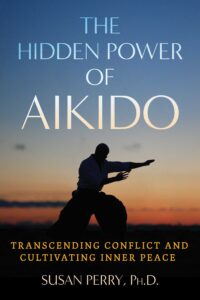
More from the author of Aikido Today Magazine
Illuminating the inner philosophical and practical aspects of Aikido, forty-seven-year Aikido practitioner and 6th-degree blackbelt Susan Perry, Ph.D., uses personal stories of joy, achievement, and hardship to demonstrate real-life applications of the transformational principles of Aikido. She introduces what Aikido is and where it comes from, providing a brief biography of its founder, Morihei Ueshiba. She explains in detail how Aikido helped her resolve difficulties at work, as a student, and as a teacher/sensei. Through each story shared, the author offers a glimpse of the beginner’s mind in action, the key to changing even the violent energy of an attack into peaceful interaction.
Presenting Aikido’s step-by-step protocol for developing the receptiveness of the beginner’s mind, a state essential to personal transformation, Perry explains how distraction and timing can be used to deescalate potentially violent or dangerous situations. She discusses the founder’s philosophy of conflict, showing how Aikido can help peacefully resolve difficulties that arise with pushy, intimidating, and unpredictable people, those who are stubborn or don’t listen, insincere people who want something from you, and chaotic situations. She explains how a deepening practice of the martial art leads to an aiki state of inner peace, fusion, and boundless joy.
Revealing how Aikido can help you face your fears and develop your heart and soul, this book shows how this martial art helps you embrace change, cultivate a strong center, and ultimately live a joyful life of engagement with the world.
You can buy the book here: https://www.amazon.com/Hidden-Power-Aikido-Transcending-Cultivating/dp/1644118971
Budo Videos

Budo Videos is a very extensive online shop specialising in budo. It features a wealth of fantastic content, and you’ll find plenty of material from Susan Peryy, editor-in-chief of Aikido Today Magazine.
If you’re interested in Japanese budo, Budo Videos is one of the best shops specialising in this subject. There’s also plenty of material here for Aikido practitioners that you’d struggle to find elsewhere.
Link: https://budovideos.com/

