
Aikido Today, January 1988, Vol. 1, No. 4
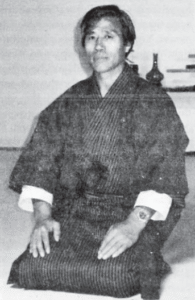
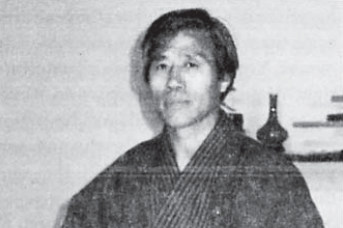
Mitsugi Saotome Sensei was the live-in apprentice to O-sensei (Morihei Ueshiba, the founder of Aikido) for fifteen years. Now living in Washington D.C., he travels to dojos affiliated with his organization throughout the U.S. His first book, Aikido and the Harmony of Nature, was published in France, where he has a very strong following. The English edition is available from Sedirep, 37 rue de la Belle Feuille, 92100 Boulogne, France.
Aikido Today: There are many books about Aikido techniques – about where to place your feet and so forth – but not so many on the philosophy of Aikido. You think of Harmony and the Way of Nature as a book on Aikido philosophy, don’t you?
Saotome: People highly respect O-sensei, but they don’t always understand him, his ideas, his personality. He used to speak about the spiritual world in a special language – a very special Japanese religious language that most Japanese people themselves can’t understand, a language of original Japanese Shintoisms. I tried to understand it, but O-sensei spoke in so many God names! On the other hand, looking through my memories of O-sensei, I think a lot of his ideas and concepts were very scientific, like his ideas of the universe, of the nature of human beings, and so on. My purpose in this book was to show these sides of O-sensei.
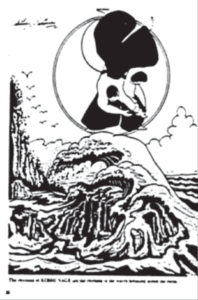 AT: The book contains many of your drawings. Did you include these drawings so that students could understand the spiritual and scientific sides of Aikido technique? Take, for example, this drawing from p.38 of your book. Would you please just go through and say how this drawing helps students to understand koshinage?
S: The rock looks like it will stay where it is, and the wave is a kind of energy, right? So the rock looks like it will cut off the wave’s energy, its circulation. But what really happens looks like koshinage. So, the drawing is my image of the power of koshinage. What happens has to do with the whole wave and the whole stone – their unity. The drawing doesn’t exactly explain how koshinage happens; it shows how to think about the energy forces.
What kind of image did you have when you started Aikido?
AT: A very confused one.
S: Maybe something visual might have given you an image. If you didn’t have a picture of anything when you were first training, that wasn’t good. When you go to climb a mountain, how can you get to the mountain without a map? (When you get there, you need another kind of map; this is technique, the topic of my next book.)
AT: A very strong idea in your book is that harmony is something natural, a force in nature. Another strong idea in your book is that aggression is a natural, instinctual part of human beings. Will you please clarify how what you say about harmony fits with what you say about aggression? In our search for harmony, should we turn our backs on the aggressive parts of human nature?
S: If you don’t have aggression, you can’t survive. People think that a tree has no aggression. But a tree has aggression too, because it’s expanding. There are different kinds of aggression. One kind causes the tree to expand. Another kind – the aggression of the tree bark – stops the expanding. But why should this be violent? If there is an adjustment, a balance, there can be harmony.
If somebody attacks you and you have no aggression, you cannot defend yourself, right? You’re studying Aikido; this is your aggression. But, when an attack comes, you harmonize. There is this kind of balance in many systems. Aggression is a way of managing a system with feedback and adjustments. A flower grows, right? It makes seeds. Bees come. Bees have aggression because they need honey. So they help each other.
The problem with aggression is that people see it as a sickness, a craziness, something egoistical and unbalanced. On the mat, if you try a technique using too much aggression, you lose your balance, your center. So, people think aggression is no good. But this is wrong. If the aggression is adjusted by feedback, there is harmony. This is AIKI.
AT: How do you know when there is too much aggression?
S: You eat food, and your stomach is limited. I have a stomach too, but a stomach of a different size. By eating too much you may make yourself sick, but I might not get sick by eating the same quantity of food. Right? The balance depends on many things.
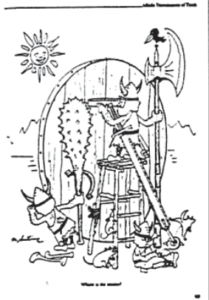 AT: Let me ask you about another drawing in your book, the one on p. 137 called “Where is the enemy?” Where is the enemy?
S: When you look at this drawing, what do you see? The big shield? The big ax? Big swords? They are too big; they can’t be used in a fight; they can’t function. So, the enemy is inside. Why are they carrying these weapons? How are they useful?
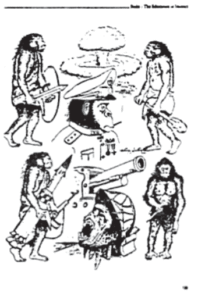 This is related to another drawing: In the beginning all life is aggressive. “The cup is mine; the banana is mine.” Then human ideas take over evolution – the heart, the brain, the thinking. From human weapons evolve the culture, government, and so on. When this happens, the enemy is not on the other side; the enemy is ourselves. This was my point in writing this book. Humans are not enemies to any other creatures. Humans are enemies to humans – because they destroy nature’s balance, the ecological system. That is the big problem.
I think Aikidoka should know the world situation. To destroy the world one time would be enough; a second time would not be necessary. So everybody has two nations. Your country is the earth, the world; you are a citizen of the world.
AT: Do you think that humans can supply this earth with a new kind of balance, perhaps using modern technology?
S: I don’t think so. Everything is limited. If we don’t take care of nature, we won’t survive. It’s as simple as that. Some technology may help. But most important of all is human wisdom. We need both: technology and wisdom. This is Aikido – studying the forces of balance.
AT: In the interview with you in East/West Magazine you said that part of the essence of Aikido is masakatsu agatsu. Were you saying that Aikido is an “inner” art – that Aikidoists should direct their attention to perfecting themselves rather than to improving the world around them?
S: No. Some think that the person must come first. They say, “I have no time to think about the world; I must make myself better.” No. We must do both at the same time. This is what masakatsu agatsu means. You’re living in your own world, right? Your life is your own world. As you try to better your world, you have more impact on society. That’s why you write your newsletter, right? It’s the same thing….extending.
AT: You studied with O-sensei for many years. Do you see yourself as doing techniques the same way he did?
S: I cannot copy O-sensei. O-sensei is O-sensei. My body is different. But I use the same philosophy, the same principles.

Aikido Today Magazine was a forum where Aikido students and teachers wrote in their thoughts. Many were the controversies about the nature of Aikido and how it should be practiced. Many articles from the beginner point of view as well as articles and interviews with seasoned teachers. ATM enjoyed correspondents from all over the world. Don’t miss out on this great material.
You can find this entire article and much more at: https://budovideos.com/products/aikido-today-magazine-e-book
 Illuminating the inner philosophical and practical aspects of Aikido, forty-seven-year Aikido practitioner and 6th-degree blackbelt Susan Perry, Ph.D., uses personal stories of joy, achievement, and hardship to demonstrate real-life applications of the transformational principles of Aikido. She introduces what Aikido is and where it comes from, providing a brief biography of its founder, Morihei Ueshiba. She explains in detail how Aikido helped her resolve difficulties at work, as a student, and as a teacher/sensei. Through each story shared, the author offers a glimpse of the beginner’s mind in action, the key to changing even the violent energy of an attack into peaceful interaction.
Presenting Aikido’s step-by-step protocol for developing the receptiveness of the beginner’s mind, a state essential to personal transformation, Perry explains how distraction and timing can be used to deescalate potentially violent or dangerous situations. She discusses the founder’s philosophy of conflict, showing how Aikido can help peacefully resolve difficulties that arise with pushy, intimidating, and unpredictable people, those who are stubborn or don’t listen, insincere people who want something from you, and chaotic situations. She explains how a deepening practice of the martial art leads to an aiki state of inner peace, fusion, and boundless joy.
Revealing how Aikido can help you face your fears and develop your heart and soul, this book shows how this martial art helps you embrace change, cultivate a strong center, and ultimately live a joyful life of engagement with the world.
You can buy the book here: https://www.amazon.com/Hidden-Power-Aikido-Transcending-Cultivating/dp/1644118971
Budo Videos
 Budo Videos is a very extensive online shop specialising in budo. It features a wealth of fantastic content, and you’ll find plenty of material from Susan Peryy, editor-in-chief of Aikido Today Magazine.
If you’re interested in Japanese budo, Budo Videos is one of the best shops specialising in this subject. There’s also plenty of material here for Aikido practitioners that you’d struggle to find elsewhere.
Link: https://budovideos.com/