

by David O’Neill and Susan Nicks — Aikido Today, Spring 1988, Vol. 2, No. 1
Born in Chicago, John Stevens now lives in Sendai, Japan, as a Zen Buddhist priest and a professor of Buddhist Studies at Tohoku Fukushi University. The instructor of the University’s Aikido Club, Professor Stevens has written many books and articles including Sword of No Sword and (under the direction of Rinjiro Shirata Sensei) Aikido: The Way of Harmony. His most recent book is Abundant Peace (Shambhala, 1987) a biography of Aikido’s founder, Morihei Ueshiba. Prof. Stevens can be contacted at Tohoku Fukushi University, Kunimi 1-8-1, Sendai, Japan (telephone 022-251-5580).
AT: Professor Stevens, what is your background?
JS: I originally came to Japan for six months to study Japanese culture and Buddhism. After being there for six months, I decided to enter a Buddhist seminary.
In the seminary we did a lot of studying and sitting. In a monastery, the study and zazen [sitting meditation] is balanced with a lot of physical labor — like weeding the garden. But, since I was in a seminary, we didn’t do any of those things. I thought I would learn some traditional physical arts, and Aikido seemed interesting. So, in the morning I would sit, during the day I would study, and in the evening I would go to the martial arts hall.
My introduction to Aikido was through a very military approach; the teachers were from the army.
For six years I trained day and night. For a while, I thought I might become a full-time teacher of martial arts. I studied some of the classical arts — kenjutsu, kendo, things like that. Then, for various reasons, I stopped being a full-time priest and got an appointment as a professor. So I ended up as a writer, in the academy, continuing my study of Aikido with university students.
AT: Who influenced you most in your study of Aikido?
JS: At first, the greatest influence on me was Saito Sensei. I knew of Shirata Sensei. His techniques were wonderful, of course, but in those days he represented the old style of Aikido. It wasn’t stated explicitly, but the feeling was we should not do that anymore.
I met Shirata Sensei when he was in his early sixties. His techniques were so hard that people found it difficult to study with him. He had no direct disciples at all. But I thought that what he was saying and the way he performed the techniques was important to preserve. So, I started going to Yamagata [to study with him]. I thought, “Everyone else has done a book about Aikido; this man certainly should have one.” So, I started working on Aikido: The Way of Harmony, which is really a tribute to Shirata Sensei — a book for him. It took three years.
My respect for Shirata Sensei knows no limits. I spent a lot of time with him because he really was a fine man — never concerned about personal glory or money.
Often, when I would go to [his dojo], I would be the only one there. One of the greatest teachers in the world and there would be nobody in the dojo! Fortunately, he has some followers now (because of my influence, I’m glad to say). He has really blossomed, and that makes me very happy. He is working on his memoirs, and I’d like to see them translated and published.
I think the most important thing in one’s Aikido career is finding a teacher one can respect and trust. It made me sad to see people stay with a teacher they can’t stand. I’ll probably get in trouble for saying this, but I know there are cases in the United States where students don’t like their teacher but stay with him because they want to practice Aikido. That makes me very sad. It’s wrong that people are forced to stay with somebody they don’t like and don’t respect. (This is very American of me to say. In Japan you would just…you wouldn’t say it, and you would keep on going.)
But, if you meet people who are really fine teachers, they can inspire you forever. To meet someone who really is a nice person — that’s an anchoring.
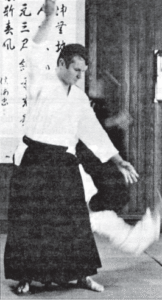 AT: How did you research O’sensei’s life for the book Abundant Peace?
JS: Most of the best, most interesting stories came from the oral literature. I’ve trained with various teachers over the years and, after the training, the O’sensei stories began. So, the main research came from the older teachers, talking in private after training.
What is remembered differs and interpretations differ. Even the way O’sensei described his enlightenment experience changed over the years. That’s a natural process. I tried to make a composite of the various stories.
The taped interviews of O’sensei are very difficult to understand. The tapes are poor quality, and, even when one can decipher what he’s saying, it’s difficult to understand. But I got some information from the tapes and some from studying the doka, his poems. Looking at the films was very valuable too, technically. But I suppose I relied mostly on inspiration rather than on pure research. I looked for a unifying view instead of just looking at what O’sensei did and where.
The book is divided into three sections. The first, The Man, puts O’sensei’s life in its historical context. The second, The Martial Artist, describes the martial arts he studied and the transformations he went through in his career. The last and most important section is The Message. Here I tried, not to be objective, but to imagine what O’sensei would say to people if he were speaking in English. This was very difficult for me because O’sensei lived in a different world — a world, now lost, peopled with gods and fairies and divinities. I had to appreciate that.
I wasn’t really concerned with the what and the where, but with the how, and with the big picture of O’sensei. Not meeting him personally might have been a disadvantage, but from the biographer’s standpoint it’s not really necessary. Often, biographies written by a person’s closest disciples are too subjective or they can’t take in the whole picture. The best biographies are written by people who never meet the subject.
AT: Are O’sensei’s religious views important to those of us practicing Aikido today in the US?
JS: The techniques of Aikido have three aspects. The first is the manifest — the form we see. The second is the hidden — what is called ki or kokyu (breath) power, depending on the teacher. And the third is the divine.
From his own level, O’sensei always explained techniques in terms of “movements of the gods.” Nobody could understand him. One technique was the function of a certain god, and another technique was the function of a different god. What does that mean? O’sensei was urging us to discern the divine aspect.
Ikkyo (the #1 pin), for example, is based on a principle that is ultimately transforming for both you and your partner. But, when you first approach it, you have to put one hand on your partner’s elbow, put the other on the partner’s wrist, and then turn your hips a certain way. At the next level, you learn how to use your ki power — how to draw out your opponents attack or movement; after some years, you can understand that. The next level is to see doing ikkyo as a sacrament, like going to church. It’s so transforming and so purifying that you feel you’ve somehow been elevated to a different level. That’s why Aikido is a Way. We should try to reach that level and not to worry about small things.
AT: In Abundant Peace, you quote O’sensei’s comment, “Ki is exceedingly complex and we must risk our lives to master it.” What do you suppose he meant by saying that we must risk our lives?
JS: That we should not be half-assed. That we should go all the way, forgetting about everything else — as in a fight to the finish.
Once in a while, we do unbendable arm and unliftable body. You learn ki power, and people can’t move you. It’s impressive. But it’s not the essence of Aikido. The essence is beyond that — to forget everything, to be intent on practice no matter how bad you feel or how sick you are…like the Marathon Monks of Mt. Hiei. They have to keep going; if they don’t finish the course, they have to kill themselves [laugh].
I did a thousand day training…up every day up at 4am for a thousand days in a row, no matter how sick I was or injured I was. It was a little ritual. I did some meditation and chanting; then I went to the temple; then I went to the mountain and sat outside; and then I did martial art training for about three hours. The energy I acquired in that intense training has sustained me all this time.
Training like this gives confidence; it builds a core inside. Once you’ve done it, you can do anything.
AT: Do you think that, in one’s practice, one should always practice the same way?
JS: O’Sensei was creative, to say the least. He was always saying that there are no techniques — that there is only Aikido and you do it. I can see why his disciples were confused. Later, when Aikido became popular, there had to be an educational system; I can understand that. But, when you study with a master of music or painting or pottery, you just stay with that person the whole time and he changes. You absorb certain things that can’t really be taught.
In my study with Shirata Sensei, who represents 60 years almost of steady continuous practice, Aikido changes all the time. He changes the names of the techniques and the way he does them. There is a tremendous difference in his Aikido when he was 60 and now when he’s 75. He’s always developing. O’sensei was the same way.
I don’t like to see people sticking to one style and saying that it is the only way to do things. Everyone has a different perspective; we’re all working out our training together. The techniques aren’t fixed. We want to try out every possibility and not be static. You get into bad habits if you always do a technique one way only. If you always begin with tai no henko (joining exercise), you only reinforce your bad habits. The challenge is often in not knowing what we are going to do today.
And yet there must be a coherent base, especially for the beginners. The core techniques remain more or less the same, but even those change subtly. You can tell when you see the 4th year students, the 3rd year students, the 2nd and the 1st year students. You really can tell in a college atmosphere because — its hard to see when you’re with the same people all the time — but even you yourself can see how your technique is developing.
In old-style budo, they’re very strict about the form and the most important thing is transmitting the form correctly. I’ve done some of the classical martial arts where the teachers are very proud of not changing anything from what their teacher taught them. That’s OK in that situation. But Aikido is different because its living, alive. There are no rules and every day is a new day…and a good day. Every day we go to practice we find something new and are refreshed by it.
AT: Would you say that your approach to Aikido is basically Japanese or American?
JS: When I’m in Japan, I do it the Japanese way. But, when I go to America or elsewhere, I like to adjust to the people there. That’s the meaning of Aikido, adjusting to wherever you are instead of trying to import cultural things without changing them. We have to be very flexible or it won’t be Aikido anymore. Aikido is organic; it expands and grows and accepts whatever cultures it comes into. If it doesn’t, it will remain something like a cult, excluding people.
AT: Where do you see the greatest hope for Aikido?
JS: I’m sorry to say that I think the Aikido that’s developing overseas is much better than the Aikido in Japan. It’s because of the cultural problems. When women get married they can’t go out; it’s almost impossible for them to continue. And, when the men get in a company after college, they often can’t practice. I’ve had 80 or 90 students pass through our Aikido club, and there’s just one or two who still practice. That makes me sad.
Also, there is a very strong emphasis on being tough in Japanese dojos. Some people who started elsewhere and then came here were very shocked. Some were beat up and hazed, which is a perversion of the message. It’s due to a sort of macho kind of jock that’s a prominent element in Japan. In that way, the Japanese culture has been a drag on the development of Aikido in Japan; it has prevented people from really practicing.
In America, though, and European countries, there are people in their thirties, forties, and fifties practicing and they bring their kids. That’s really what Aikido is all about.
It’s not only me. There are Japanese teachers who say, “Aikido has gone overseas, and the people who have been practicing overseas will have to reintroduce Aikido to Japan.” I think that is true, that it is happening already. Some of the best practitioners are overseas now, the top disciples. When the present generation of senior teachers (like Shirata Sensei) pass from the scene, it will be equal. The third generation, the fourth generation, the future of Aikido is overseas. Aikido will have to be reintroduced to Japan.

Aikido Today Magazine was a forum where Aikido students and teachers wrote in their thoughts. Many were the controversies about the nature of Aikido and how it should be practiced. Many articles from the beginner point of view as well as articles and interviews with seasoned teachers. ATM enjoyed correspondents from all over the world. Don’t miss out on this great material.
You can find this entire article and much more at: https://budovideos.com/products/aikido-today-magazine-e-book
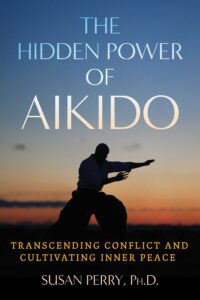 Illuminating the inner philosophical and practical aspects of Aikido, forty-seven-year Aikido practitioner and 6th-degree blackbelt Susan Perry, Ph.D., uses personal stories of joy, achievement, and hardship to demonstrate real-life applications of the transformational principles of Aikido. She introduces what Aikido is and where it comes from, providing a brief biography of its founder, Morihei Ueshiba. She explains in detail how Aikido helped her resolve difficulties at work, as a student, and as a teacher/sensei. Through each story shared, the author offers a glimpse of the beginner’s mind in action, the key to changing even the violent energy of an attack into peaceful interaction.
Presenting Aikido’s step-by-step protocol for developing the receptiveness of the beginner’s mind, a state essential to personal transformation, Perry explains how distraction and timing can be used to deescalate potentially violent or dangerous situations. She discusses the founder’s philosophy of conflict, showing how Aikido can help peacefully resolve difficulties that arise with pushy, intimidating, and unpredictable people, those who are stubborn or don’t listen, insincere people who want something from you, and chaotic situations. She explains how a deepening practice of the martial art leads to an aiki state of inner peace, fusion, and boundless joy.
Revealing how Aikido can help you face your fears and develop your heart and soul, this book shows how this martial art helps you embrace change, cultivate a strong center, and ultimately live a joyful life of engagement with the world.
You can buy the book here: https://www.amazon.com/Hidden-Power-Aikido-Transcending-Cultivating/dp/1644118971
Budo Videos
 Budo Videos is a very extensive online shop specialising in budo. It features a wealth of fantastic content, and you’ll find plenty of material from Susan Peryy, editor-in-chief of Aikido Today Magazine.
If you’re interested in Japanese budo, Budo Videos is one of the best shops specialising in this subject. There’s also plenty of material here for Aikido practitioners that you’d struggle to find elsewhere.
Link: https://budovideos.com/