
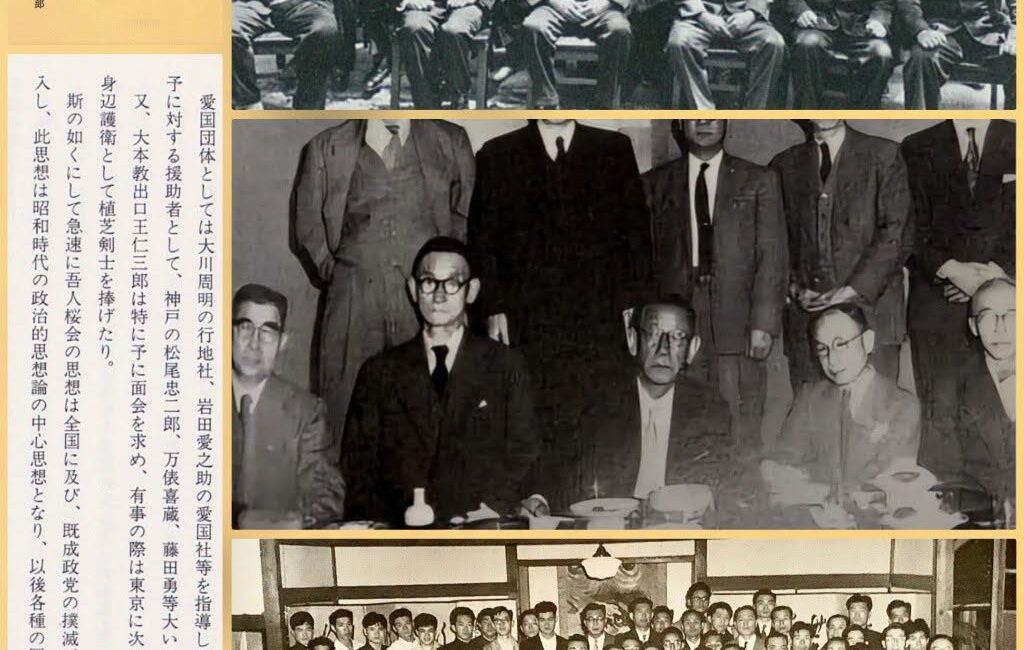
Reposted from the Aikido Sangenkai Facebook page with the kind permission of Christopher Li Sensei. This article is part of the “Exploring Historical Photos” series, produced in collaboration between Aiki-wiki and Aikido Sangenkai.
It’s often asked if Morihei Ueshiba was actually actively involved in terrorist activities.
The short answer to this question is… “yes”.
This was discussed in some detail in “Morihei Ueshiba, the Black Dragon Society & Pre-War Japan – What Aikido’s History Doesn’t Tell You”:
It’s important to note here that Morihei Ueshiba himself was a very minor participant.
It’s also important to note that the most important incident of his active participation really collapsed before it started.
That notwithstanding – collusion or conspiracy to commit an act of terrorism is criminal… even if the act never actually occurs, by the laws of virtually every country in the world, including the US, Japan, and the EU.
However, the intent of this discussion is not to argue criminality, nor is it to argue that Morihei Ueshiba ought to have been prosecuted, as were some of the other, more important, participants.
The intent and importance of this discussion, really, is to place Morihei Ueshiba’s ideals, idealogy, and rhetoric in the context of his historical actions.
The Sakurakai (Cherry Blossom Society) was a right wing ultra-nationalist terrorist group led by Colonel Kingoro Hashimoto and backed by Morihei Ueshiba’s close friend Shumei Okawa (who provided much of the theory from the background), and whose meetings were hosted by Morihei Ueshiba in his home (as noted, among others, by Morihei Ueshiba’s direct student Iwata Ikkusai).
The Sakurakai was behind at least two terrorist coup attempts in 1931, the March Incident and the October Incident, also known as the Imperial Colors Incident.
Arguably, hosting the Sakurakai meetings in his home, alone, brings Morihei Ueshiba into the realm of collusion and conspiracy, albeit in a very minor capacity.
However, with Morihei Ueshiba’s agreement to active participation in the Imperial Colors Incident he clearly crossed the line into active participation in a terrorist activity.
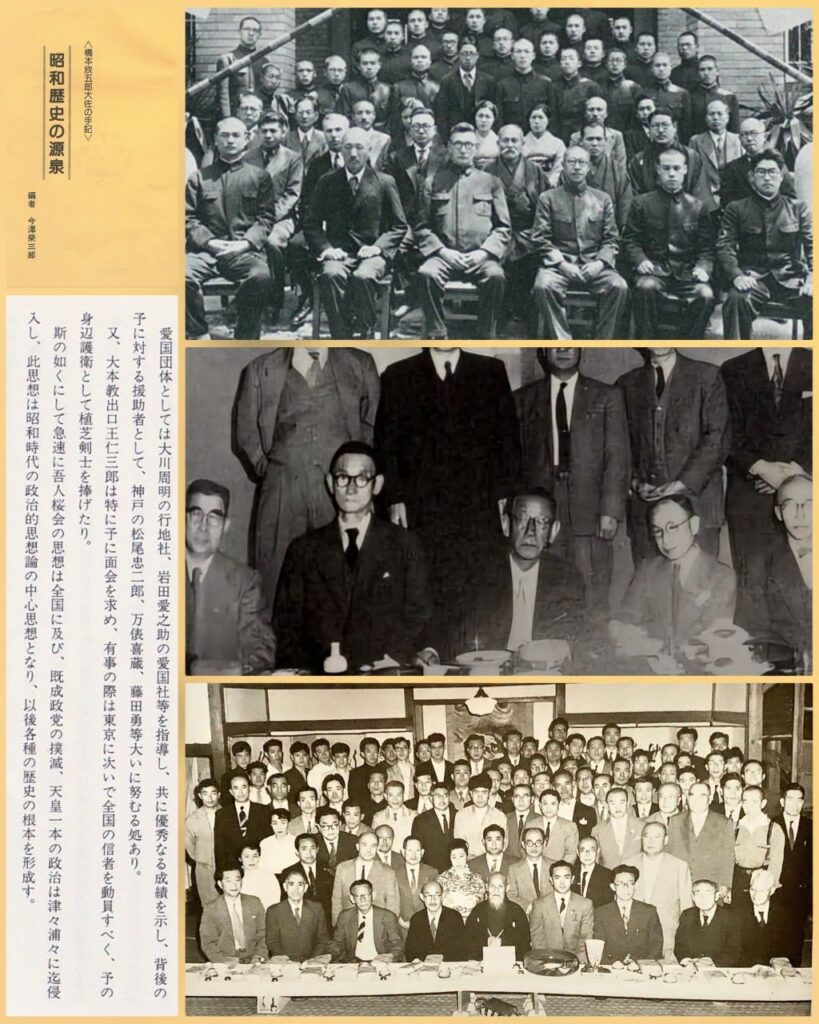
Take a look here at the attached photo.
On the left side of the attached photo is a section of Colonel Kingoro Hashimoto’s notes, originally handwritten, from 1936 – just five years after the the Imperial Colors Incident, which was a failed attempt to assassinate major Japanese government officials, seize the Imperial Palace, and forcibly impose the Showa Restoration and a military dictatorship under General Sadao Araki backed by Morihei Ueshiba’s close friend, Shumei Okawa. The aforementioned Sadao Araki, it should be noted, was actually a student of Morihei Ueshiba:
“Among the groups which led the way, showing support for the action were Okawa Shumei’s Koukisha and Iwata Ainosuke’s Aikokusha, together showing excellent enthusiasm. Among those behind the plot were these supporters: Matsuo Chujiro of Kobe, Mandawara Kizo and Fujita Isamu. Moreover Deguchi Onisaburo especially sought an interview with me. He said he would mobilize his followers in Tokyo and then throughout the country, should the need arise, and he would give me Ueshiba Kenshi as a bodyguard.”
– Translation from “Transmission, Inheritance, Emulation 9a / 22a”, by Peter Goldsbury
This group had recruited 120 members of the Sakurakai, ten companies of troops from the Imperial Guards and ten bomber aircraft from the Imperial Japanese Navy, as well as thousands of Omoto believers, Morihei Ueshiba himself, and a number of Morihei Ueshiba’s students.
Kingoro Hashimoto further elaborated on the incident in an oral account (also translated by Peter Goldsbury) given in 1957, which largely matches his earlier written account, but is more detailed:
“About ten days before the revolt [The October / Imperial Colors Incident, 1931] was due to take place, Onisaburo Deguchi and Morihei Ueshiba met Hashimoto through the good offices of Fujita Isamu. The meeting took in place at Fujita’s residence in Reinanzaka, Tokyo. Deguchi sat in all his glory in an elegant reception room.
When Hashimoto entered the room, Deguchi checked that he was speaking to Hashimoto of the General Staff Headquarters and then stated that he had heard that Hashimoto was going to ‘change the world’. Hashimoto’s memory was somewhat rusty about what followed, but he stated that Deguchi offered the help of 3,000 Omoto believers. There would be 10,000 on the following day and up to 100,000 believers in Tokyo could participate. Hashimoto was very pleasantly surprised. Deguchi then stated that he would furnish him with a bodyguard to protect him. He pressed a bell and Morihei Ueshiba entered from the adjoining room.
Ueshiba made an obeisance to Deguchi in deep seiza (as if to the emperor) and asked what Deguchi wanted him to do. Deguchi answered that Mr Hashimoto was going to change the world and told Ueshiba to give him personal protection.
Ueshiba assented and retired to another room. Deguchi then indulged in small talk for 20 or 30 minutes and then left.
[material omitted]
Immediately after the meeting with Deguchi, Hashimoto had a meeting with Morihei Ueshiba. Ueshiba promised him that the instant anything happened, seven experts in aiki-budo would be near him. Although seemingly few in number, they had the power of 70, so that Hashimoto should not worry. If necessary, on the second day the seven could be increased two or three times.”
– Translation from “Transmission, Inheritance, Emulation 9a / 22a”, by Peter Goldsbury
On the top right of the attached photo sits Morihei Ueshiba, behind and to the right of Okawa Shumei, in 1943 at the graduation of a group from Okawa Juku – the Pan-Asian ultra-nationalist indoctrination center run by Okawa Shumei at which Morihei Ueshiba was an instructor. Morihei Ueshiba would remain close friends with Okawa Shumei after the war, until his passing.
In the middle right photo sits Shumei Okawa, second from left, front row, next to Kingoro Hashimoto, amid a 1956 reunion of the group behind the 1931 March Incident, the Sakurakai backed coup d’etat intended to provoke the implementation of martial law and the installation of a military dictatorship which ultimately collapsed – this was the event preceding the Imperial Colors Incident in October of the same year in which volunteered to participate.
On the bottom right is a celebration for Kingoro Hashimoto at Aikikai Hombu Dojo in 1956, after his release from prison under the general amnesty.
Kingoro Hashimoto sitting two to the left of Morihei Ueshiba.
Now, one may argue that Morihei Ueshiba’s participation in the the Imperial Colors Incident relies entirely upon the two accounts from Kingoro Hashimoto.
That’s a valid point, and we have to consider whether Kingoro Hashimoto’s account was reliable and believable.
Some of the main points:
1) The two accounts match, even though they were recorded more than ten years apart, and the second account notes that the account was made from memory.
2) At neither time was Kingoro Hashimoto under any danger of prosecution, nor would there have been anything for him to gain by naming either Onisaburo Deguchi or Morihei Ueshiba, both of which were mentioned in a passing manner, nor was he under any kind of duress.
3) In fact, Kingoro Hashimoto was markedly unapologetic after the war, only apologizing to the Japanese people that his actions had failed to achieve their goals, and these accounts fit into that narrative.
4) Morihei Ueshiba’s language in Kingoro Hashimoto’s account was bombastic, but it was also typical of Morihei Ueshiba’s language in general – for example, Morihei Ueshiba would often claim the ability to dodge bullets, and other great powers.
5) Kingoro Hashimoto enjoyed a long, and friendly, relationship with both Onisaburo Duguchi and Morihei Ueshiba from shortly after the Mongolian Expedition in 1924 to Kingoro Hashimoto’s passing in 1957 – more than 30 years.
In short, while one will have to decide for themselves in the end, there is really very little reason to doubt Kingoro Hashimoto’s account, and every reason to find it believable, leading to the conclusion that Morihei Ueshiba did, indeed, actively participate in terrorist activities.
[…] Morihei Ueshiba and Terrorist Activities […]