
Reposted from the Aikido Sangenkai Facebook page with the kind permission of Christopher Li Sensei. This article is part of the “Exploring Historical Photos” series, produced in collaboration between Aiki-wiki and Aikido Sangenkai.
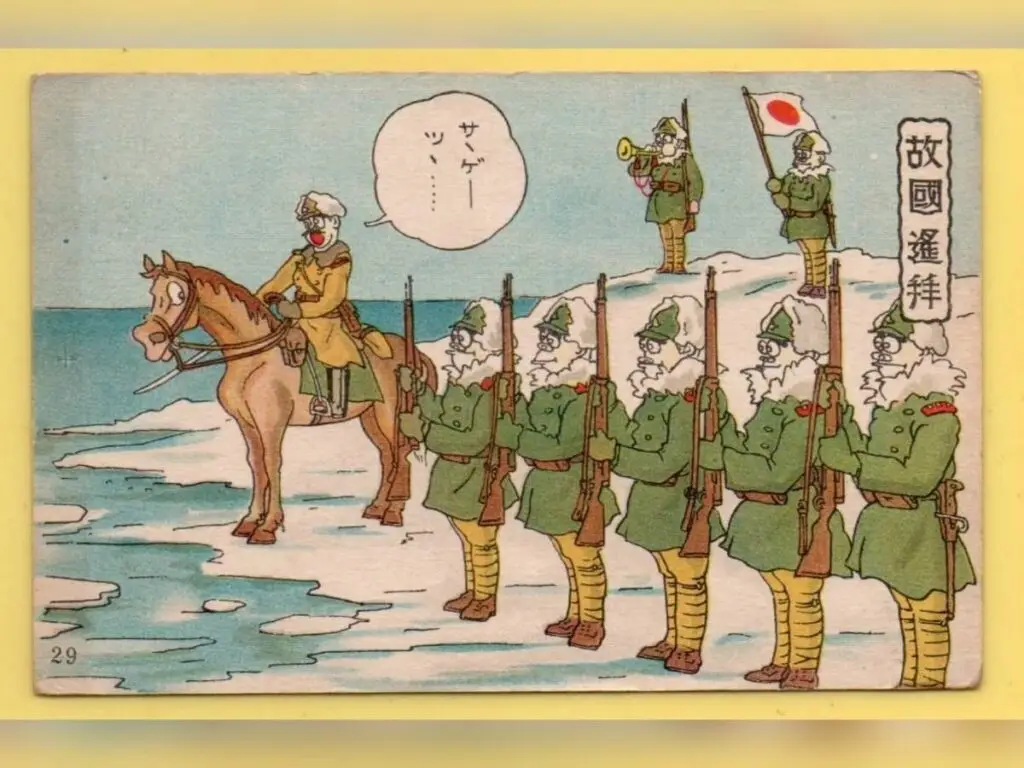
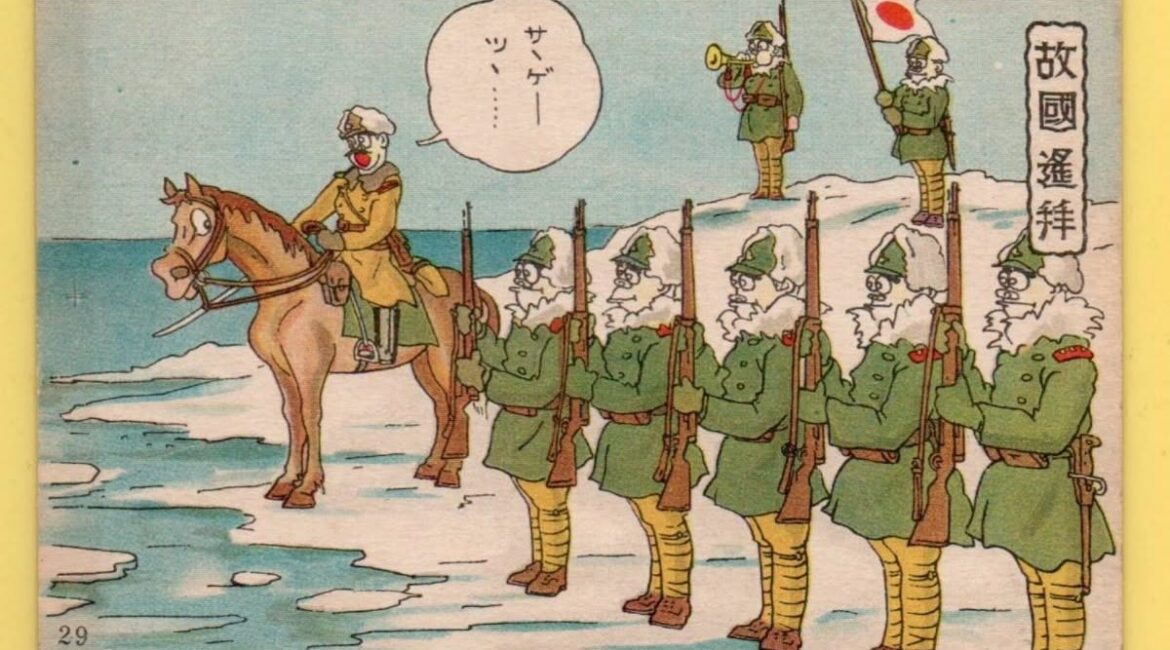
“Paying homage to my homeland from afar” – a postcard from the Kwantung Army, the division that was largely responsible for the Japanese occupation of Manchuria, and which contained Unit 731 – the unit responsible for numerous acts of biological warfare and experimentation on Allied prisoners.
General Sadao Araki and Prime Minister Hideki Tojo, both students of Morihei Ueshiba, served in the Kwantung Army.
This is all relevant to Morihei Ueshiba through his teacher Onisaburo Deguchi’s close ties to the Kwantung Army, as noted here by Stanley Pranin:
“Onisaburo’s group was secretly supported by Japanese nationalist groups of the highest level in alliance with the Kwantung Army. This army was a quasi-independent part of the Japanese Imperial Army and little by little was bringing Manchuria under its control. Deguchi was deeply involved with the behind-the-scenes politics of the region, and he, the Japanese army and nationalists found each other useful in furthering their respective agendas.”
“Onisaburo had a calculating and opportunistic side to his nature. After the party’s return to Japan (Note: this is referring to Deguchi’s expedition to Mongolia with Morihei Ueshiba), he and his party were thrust into the public spotlight due to the intense coverage of the media of their Mongolia adventure. Some scholars have even advanced the view that the leaders of the Kwantung Army essentially adopted Onisaburo’s plans for the creation of a Utopian nation with the establishment of Japanese-controlled Manchukuo.”
– “How War and Religion Shaped Modern Aikido”, by Stanley Pranin
Further, here is part of the discussion by former International Aikido Federation chairman Peter Goldsbury:
“The connection between Omoto and the Army in Manchuria was extremely close. Before the Mukden Incident, the two key officers involved, Itagaki and Ishiwara, visited Onisaburo Deguchi in Kameoka to discuss the Manchurian problem, the establishment of a militarist national-defence state and the domestic reconstruction of Japan. They were particularly interested in Deguchi’s ideas on Manchuria, in view of his earlier experiences there. Deguchi also had contacts with Lt. Gen. Tatekawa Yoshitsugu, the Headquarters Chief of Operations, who had been sent to Mukden by the Central Army Headquarters and the government on the very night of the Sept 18 Incident, in order to stop the young field-grade officers from taking action. However, Tatekawa had allowed himself to be detained and entertained in a geisha house, while the Incident was being arranged and set in motion. Deguchi and Tatekawa had agreed on the importance of establishing Manchuria as a monarchy and of persuading Henry Pu-yi to become Emperor. Later, Tatekawa sent a telegram to Deguchi expressing thanks for the help of the Jinrui Aizenkai during the military expansion that followed the Incident.”
“One of Onisaburo Deguchi’s talents was his ability to adapt the Omoto organization to the changing spirit of the times. Thus, in the Taisho period, Omoto was in the vanguard of a Taisho Restoration, in which the emperor would become the agent of Kuni-no-koto-tachi-no-kami in the purification and unification of the world. Then, in the Mongolian Expedition, Deguchi claimed to be the personal agent of the Imperial House in central Asia. During this international period, however, the controlling assumption was always Japan’s spiritual superiority. Later, in early Showa, the political atmosphere became nationalistic and anti-foreign, so Omoto energies were once more directed to traditional nativism and concurrence with the ideals of Uchida Ryohei and Toyama Mitsuru.
In 1931, Omoto called together a conference in Kameoka to discuss the developing situation in Manchuria. The Omoto Jinrui Aizen Shimbun greeted the resolutions of the conference:
“Mindful of the great mission Japan has received from Heaven, stand aloof from all confrontation activities, but complete the task of guiding the development of Manchuria and Mongolia! Go abroad to all the countries of the world, reform cowardly behavior; go forward and propagate the mandate of Heaven! When nations do not understand the above decree, by all means press on (with this mission) resolutely by yourselves. Even if it is necessary to occupy Manchuria and Mongolia, definitely do not occupy China. This occupation is aimed at the punishment of the tyrannical Chinese army clique and most certainly do not make the Chinese people the enemy. The occupied lands must rightly be put under the benevolent government of Japan… and the leading people must establish the primary policy of governing by their virtue.” (Quoted by Nadolski on pp.173-174.)
After the Mukden Incident, Omoto proclaimed that the two doctrines: (a) that all men were brothers; and (b) that Japan had a special mission to reform the world, were not really contradictory. The Jinrui Aizen Shimbun proclaimed that Japan’s expansion was to be based on the purification of the culture of the Far East by eliminating all the dross elements. The Zuisho Shimbun considered that the expansion being carried out by the Imperial Army was qualitatively different from the colony grabbing of the other powers, because the Japanese Army was a “holy instrument of peace”. From 1931 till 1935 the Omoto press poured out a torrent of similar justifications for the Army action in Manchuria & China, which attempted to justify these acclaimed activities with the renovation of the world traditionally advocated by Omoto.”
– “Transmission, Inheritance, Emulation 9”, by Peter Goldsbury
Onisaburo Deguchi’s grandson, Kyotaro Deguchi, always maintained that his grandfather was a staunch pacifist, persecuted by the Japanese government during the Omoto Suppression, and this is largely the narrative that is maintained by Omoto today.
However, this is essentially a misrepresentation by a grandson and successor.
As we can see from the above, Deguchi was really an opportunist whose goals would shift when he saw advantage.
The reality of the historical record shows two main reasons for the government suppression of Omoto:
1) “Lèse-majesté” – Deguchi’s assumption of Imperial regalia and symbology coupled with continuous insinuation that he was the “legitimate” representative of the Imperial line. This is the reason most commonly cited by Stanley Pranin.
2) Deguchi’s continuous involvement with the Kwantung Army, the Sakurakai, and others actively plotting the violent overthrow of the Japanese government.
The latter is made clear in this police report excerpted by Peter Goldsbury in “Transmission, Inheritance, Emulation 9”:
“When we looked at the activities of the Showa Shinseikai, there were signs that it was in one respect joining hands with the Army. There was much coming and going of officers on active duty…The initial reason why we thought we had to investigate Omoto was that if the Army and such a right-wing organization united and staged a coup d’état, there would be grave danger. If, like the February 26 1936 and May 15, 1932 incidents, an emergency arose and the patriotic societies would stand up and act in concert, the maintenance of public order would be difficult. Then, to prevent any planned Army coup d’état, we directed an investigation to see to what degree the Shinseikai and the Army were related.” (Nadolski, p. 254.)”
[…] Postcard from the Kwantung Army […]