Interview
Eric Graf: How was your experience as a coach ?
Michele Quaranta: I learnt how to motivate people who don’t feel like it, how to instil the attitude into them. Regarding the behaviour and the moves, I tried to have them understand the principles of Aïkido without telling them what Aïkido was. There are many common grounds between Aïkido and football: in football, you come across the randori, you must know and recognize the space, you must work hard on your balance, your centring; you must know how to perceive the location of your partners and the one of your opponents. Finally, we use the principles of dodging, of anticipating; It is also about knowing taking up a position !
What was your position in the game?
Midfield player, number 6.
Why did you stop playing football ?
I never really stopped but I dedicated myself to follow Ikeda Senseï. I asked him if I could be his pupil. In the course of the first eighteen years, I intensively worked as an uke and assistant, which made me develop tremendously and brought me a lot.
When, why and with which Sensei(s) did you start Aïkido?
My first Senseï was a Swiss, Werner Hintermann, at Basel’s aikikai. He showed very much patience with me because I bombarded him with questions and he took the time to answer them and, trough this, to make me understand the values of Aïkido. He himself is one of the founder members of the ACSA (Swiss cultural association of aïkido). The first Japanese Senseï with whom I attended a seminar was Tamura Sensei, then followed Sensei Tada, Fujimoto, Hosokawa, Asai, Chiba and many others.
When did you first meet Ikeda Senseï and what was your first impression ?
It was back in 1977… feeling: an extremely strong person, I was impressed by his preciseness; I was fortunate he spoke my mother tongue (Italian). It was in Basel’s Dojo (aikikai), approximately five years after I started Aïkido.
What is the difference between Aïkido at the time you started and the type we practise now ?
It is very simple, in the beginning, we would watch and copy, there wasn’t any explanation, everything was to be understood through the body and the confrontation, Aïkido seemed very complex. Now, the teachers’ knowledge is such that you have the opportunity to understand what you practise. Ikeda Senseï made Aïkido teaching develop by explaining the bases. He dismantled Aïkido just like one would dismantle a mechanical watch, then he rebuilt it and, through this process, made a logic appear.
Which was the most difficult technique for you when you started ?
Shihonage.
When did you open your first dojo ?
In 1983, in Basel (the current Dojo is the third one).
Besides football and Aïkido, you worked in a bank ; how did you find the strength to quit a safe job to start something that didn’t offer any guarantee ?
It was born in myself, I felt it, I don’t know if it is a vocation. I made this decision in a rather peculiar situation. One day, at work, during the six days’ war in the Middle East, I listened to one of my co-workers and one of them cried out rather loudly to my ears, with an expression of joy in his voice: “Ah, they are fighting again, very good for me, gold will go up et I will make money!”. I was shocked that one could look forward others’ unhappiness to earn a few thousands of francs. This showed me that what I was about to do was right and that I could no longer work in a bank where money was rated above human beings (two years later, the bank closed).
Until what age did you work at the bank ?
Until 1983. I had other jobs before that: coordinator in the compensation’s markets between France, Switzerland and East Germany.
When did you start travelling in other countries in order to teach Aïkido ?
Approximately ten years ago, the first country was Slovakia.
How many trainings per week do you give in average ?
Approximately seven, but it can go up to twelve !
How many seminars per year do you give in average ?
Approximately thirty, four of which last more than a week.
Editor’s note: Out of a month, Michele spends, in general, one week in Czechia, where he teaches at the Prag’s Aïkido Ikeda-Dojo and approximately two weeks in Switzerland, where he teaches in his Dojos in Basel, Neuchâtel and La Chaux de-Fonds. The rest of the time, he spends it abroad where he gives between two and three seminars of one weekend each per month.
How and why did you shave your mustache ?
I got my hair and my mustache cut the day when I decided to dedicated myself to Aïkido only. I went to Ikeda Senseï (still with my mustache) and told him that, from then on, I would totally dedicated myself to Aïkido, it was 7-8 years ago.
Please, tell us about a situation which really had a strong influence on you.
Meeting Werner Hintermann changed my life.
If you could say one thing to all the inhabitants of the earth, to all the people who practise Aïkido, to all of your students, what would it be?
I would tell them not to keep what they have. Knowledge accumulates by giving. In brief, don’t hold back, let go.

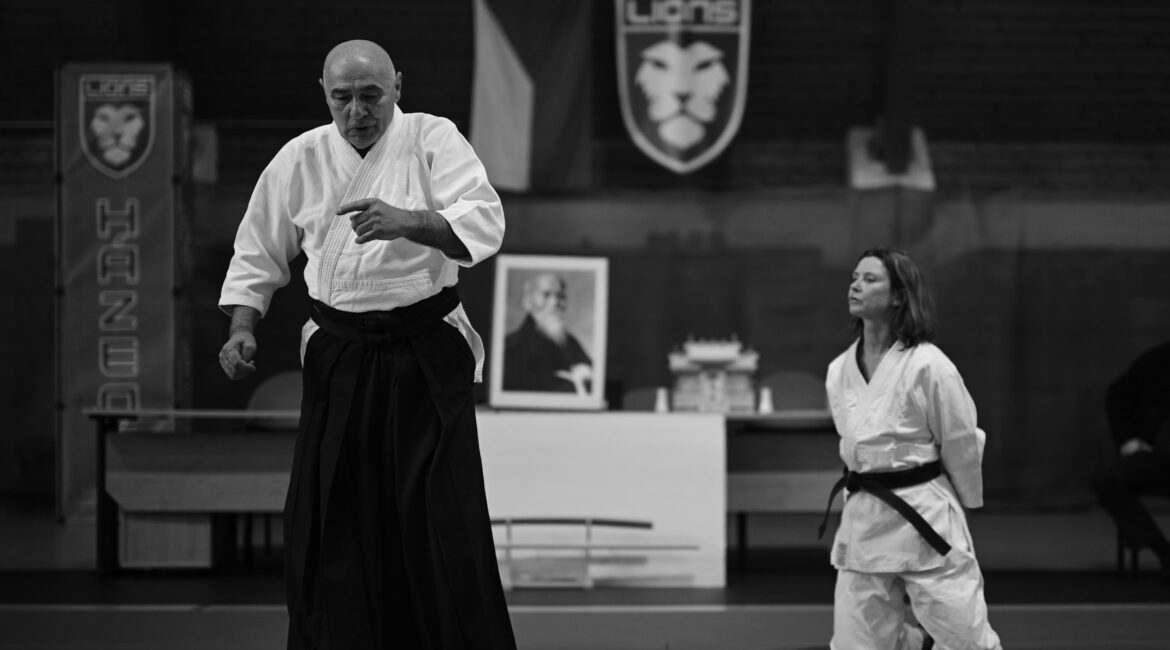
 Michele Quaranta was born in Forlimpopoli ( ‘Forum popili’, an historic town founded by the Romans where people came for the market), on the 24th of December 1953. Senseï is therefore a Capricorn, and a Snake according to the Chinese calendar. The oldest of her sisters lives in France, the youngest in Italy, one of his brothers dwells in New York whereas the other one has settled in Rio de Janeiro ! The family spread out all over the world ! Michele lived in Italy until the age of 6-7, then in Alsace (France) where he carried out his schooling. From the age of eleven on, he came and lived in Switzerland but kept on going to school in France.