
This article was originally published in the first issue of the magazine “Sanshinkai Letters”. The magazine “Sanshinkai Letters” was published by Eric Graf Sensei. All issues of “Sanshinkai Letters” can be found on Graf Sensei’s website: https://graf-dojos.ch/ in the “Downloads” section. We are publishing this article here with the kind permission of Eric Graf Sensei.



Masatomi Ikeda (Aikikai CH)
Here I would like to talk about the technique Genkei-kokyunage. How many of you can visualize it when they hear its name? Although I show it at every seminar, it is difficult for you to associate the technique with its name, as you do with Tenchinage, Iriminage or Kotegaeshi. In my opinion, there are three reasons for this:
- Genkei-kokyunage is a personal designation and not a common name in Aikido’s world.
- You give another name to this technique.
- This technique doesn’t have its own name as it is the case for Tenchinage or Iriminage.
What kind of technique is Genkei-kokyunage then?
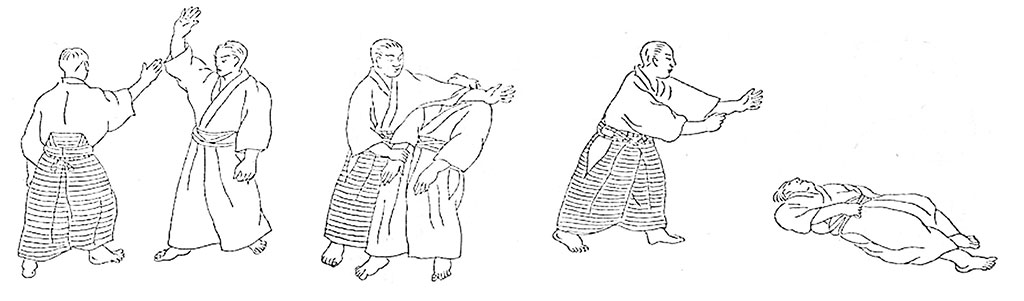
It is a technique that one trains daily to develop the energy necessary (Kokyu-ryoku) to practise Aikido techniques. This is also known by you as the technique Kokyu-ho on Katate-ryotetori (9th form).
Although it is a matter of a technique known by all Aikido students, you have a hard time visualizing something before I show it to you. The third reason mentioned above is most probably the main one: this technique has no specific name.
Against that, a few of you could argue that it has a name and that it is called Kokyunage. In fact, we often call it Kokyunage when we train Kokyu-ho. The designation Kokyunage is not specific to this technique. We use it temporarely, for it has no peculiar name. Kokyunage is a general appellation for all Aikido techniques. Techniques such as Iriminage or Kotegaeshi are “Kokyunage” as well. You know it, one uses sometimes the denomination Kokyunage to designate all the techniques that have no specific name, in order to distinguish them from those that have their own name.
Others may claim that this technique is precisely called Kokyu-ho. But as I mentioned earlier, Kokyu-ho is nothing else than a method for developing the energy necessary to practise Aikido techniques. For Japanese people, or those who understand the Japanese language, the meaning of “Kokyu-ho” is certainly obvious. However, for the others, who take this word in an acoustic way and just use it to refer to the technique, it is probably not obvious.
Only one thing is thus obvious, it is the fact that this technique has no specific name. Why didn’t we give any specific name to this technique till now? It is very interesting to think about this. First, I would like to explain a few reasons why I dare to name it “Genkei-kokyunage” and why I attach a particular importance to it.
First I called it once this way, for the work without any name was rather inconvenient. When a technique owns a specific name, it is then possible to represent it without that one shows it beforehand. In a similar way, we need a name in a conversation or in a book. When we use the designation Kokyunage to design a technique, we can’t know to what it refers. We have to supply complementary explanations: “I mean the Kokyunage which we use when practising Kokyu-ho”. I was able to make the situation simpler by calling the technique Genkei-kokyunage. Of course, this isn’t the main reason that made me call it this way. I rather did so because as I noticed the rich content and the value of this technique.
Now I would like to ask you one question: how do you appraise Tenchinage? In my opinion, Tenchinage is ideal to understand the feeling of a technique, for the teacher as well as for the students. It is a technique which must belong to the beginners course, for it is easy both to explain and to understand. I regard Tenchinage as one of the most important techniques in Aikido. The more I train this technique, the more this opinion strengthens. To put it in a way that is a little excessive, I consider Tenchinage to be The technique par excellence.
In this meaning, I regard Genkei-kokyunage as the only technique comparable to Tenchinage. So I understand these two techniques as the two parts of a whole, one being inseparable from the other. If we could compare Tenchinage with Genkei-kokyunage in this way and attribute the same value to both of them, then it wouldn’t be that difficult to gather Aikido techniques in one system.
Genkei-kokyunage is therefore a remarkable technique. We owe to train seriously both of these techniques (Genkei-kokyunage and Tenchinage), in order to try to improve them. According to my designation, Genkei-kokyunage means “the most profound of all techniques”. I named this technique so because I am convinced of this. Most Japanese people, when they hear the name, understand “gen” as “origin” and rarely understand what I really mean.
Usually, when a technique has a name, it means that it is very important. Since it is important, we pass it on, keep it and give it a name. Why haven’t we given any name to Genkei-kokyunage so far, since this technique becomes as important as Tenchinage when we compare it with other techniques? This question is a real mystery to me. I would like to submit a few reflections on some possible reasons:
- Don’t they regard this technique as much as I do myself? This is certainly not the case. A lack of attention and an underestimation toward this technique would reveal an immaturity on the part of those who practise Aikido.
- The reason may be simpler: it is not easy to find an appropriate name for this technique. With this argument, we get probably closer to the truth. Actually, we resign ourselves to refer to this technique by “Kokyunage”. Except for the confusion that arises when we ask “which Kokyunage?”, the name Kokyunage fits perfectly this technique. I myself have called it temporarily Genkei-kokyunage in order to avoid such a confusion. And yet, I am still not really satisfied, although it was a long way for me to come to this. Contrary to this Genkei-kokyunage, Tenchinage is a technique which forms a inseparable unity with its name. No other name describes as well the content and the deepness of the technique as Tenchinage. In the word tenchi (sky-earth), one can even already perceive the philosophical profoundness… If Genkei-kokyunage is a technique comparable to Tenchinage, and must therefore be trained with great meticulousness, it must receive a name that is not inferior to the one of Tenchinage. If it is so, the designation of Genkei-kokyunage becomes even more difficult.
- When we talk about Aikido techniques, or when we rate them, we could imagine that there is no need to mention Genkei-kokyunage, if we consider that there are some other techniques which have their own name and which are not inferior to Genkei-kokyunage. Thanks to the so-called four great Aikido techniques, Ikkyo, Kotegaeshi, Iriminage and Shihonage, it is possible to explain and rate all techniques. With the conviction that these techniques represent Aikido’s basic techniques and that they stand in the centre, it wouldn’t have been necessary to bring out Genkei-kokyunage by giving it a name of its own. But when we explain why Ikkyo, Kotegaeshi, Iriminage and Shihonage represent the core techniques and the last secret techniques, that is to say Aikido’s quintessence, we always mention Genkei-kokyunage along with Tenchinage. Through these techniques, we determine the four above-mentioned techniques’ value, position and grounds for existence. I would like to explain this whole thing at the earliest opportunity.
- Genkei-kokyunage was not given any name because it is a secret technique. What do you think of this argument? In the other budo’s traditions, there are still nowadays some schools, in which the real techniques are trained in forms that the uninitiated can’t recognize. I would like to illustrate this with the example of Tenchinage and Genkei-kokyunage. We give for example the name omote-no-wasa (visible technique) to Tenchinage and we train it as an exercise technique. At the same time, we must master the ura-no-wasa technique (invisible technique) Genkei-kokyunage, so that Tenchinage becomes a real technique, which is efficient in reality.
I don’t know if the Genkei-kokyunage was simply passed on orally and kept as a secret nameless technique. I can, on the other hand, say very clearly that the Genkei-kokyunage contains the value relating to the secret part or is the ura-no-wasa of Tenchinage. If it is true that the Genkei-kokyunage represents a secret technique in Aikido and that, on that ground, one does not give it a name, I make a “mistake” by writing an article on that topic. But today, in our modern world, I would find insane to keep secret a technique, or to hide it, as they would have done in ancient times. All in all, each Aikido technique represents a secret technique, the final technique. And all of us who practise Aikido know through our experience that it isn’t possible to understand Aikido by simply watching.
I have explained during long times that it is impossible to talk about Aikido techniques without giving to the Genkei-kokyunage its own name and to acknowledge that it has the same value as Tenchinage. I also said that you can improve your own Aikido fastly and bring it to its highest level if you focus your attention on the Genkei-kokyunage by improving it by the practice. Perhaps can you now understand the reason why, in each Aikido seminar, I introduce the Genkei-kokyunage.
At the earliest opportunity, I wish to explain that the framing structure of Aikido techniques forms by giving a specific name to the Genkei-kokyunage. Finally, I would like to introduce the thesis according to which the Genkei-kokyunage and the Tenchinage are techniques which represent the foundations of the four great Aikido techniques. Please, think it over.
Zürich, 15.01.1993
[…] Gen Kei Kokyu Nage by Masatomi IkedaAutor: Ladislav Kořan2026-07-17 […]