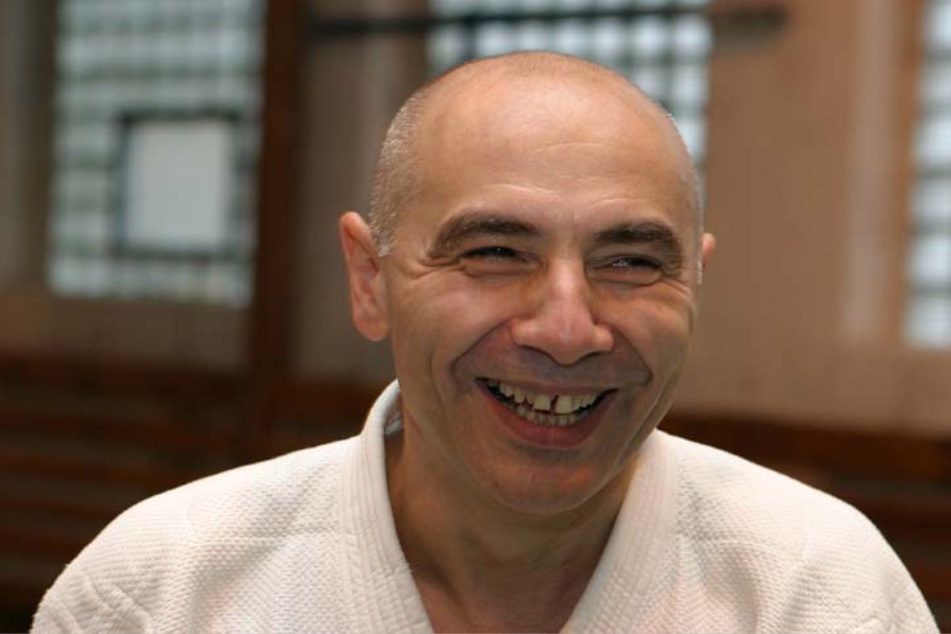
The interview took place on July 2, 2025, in Soběslav during the Aikido Summer School organized by Aikido Czech Republic.
The interview was conducted and transcribed by Ladislav Kořan
Translation and proofreading: Halka Baláčková
Photos courtesy of Halka Baláčková, Eric Graf, and Jaromír Vitásek
The interview was translated into English by Tomáš Suchan
Sensei, how did you encounter Aikido and the man who told you about it?
Michele Quaranta: But I’ve already told you this story.
Could you please repeat it for our readers?
I once had a break at work. I worked at a bank, and there was a spiral staircase. I was just walking up the stairs when I met a stranger in the middle. The man pointed at me and said, “You should start doing Aikido.” That made me curious. He told me that he was going to a nearby dojo the next day and that he’d take me with him. I continued upstairs, and the man vanished. That was all. The whole thing was kind of strange. The next day, he really took me there. We had some time to chat on the way. “I practice aikido, but I usually train in France,” he said. We finally got to the dojo. As I watched the keiko, I thought to myself: “This is exactly what I need in my life.” The man left in the middle of the training, leaving me there alone. I couldn’t find him at work the next day.
He went back to France. Since then, I’ve searched for him everywhere, my whole life, but I never managed to meet him again. He has my biggest thanks.
Who was your first teacher?
My first Swiss teacher was Werner Hinterman Sensei. The first Japanese teacher I got to know was (Nobuyoshi) Tamura Sensei. He came to our dojo once a year and led a class, which was almost entirely private. Well, there were only ten of us after all.
What teachers did you encounter before you met Masatomi Ikeda Sensei?
The first was Tamura Sensei, the second was Tada Sensei. I met Fujimoto Sensei, who was Tada Sensei’s uke. We got to know each other quite well and became friends. Then I met Sensei (Jun) Nomoto and many others. Sensei Ikeda was supposed to be the next Swiss Shihan. By the time he arrived, I had been practising Aikido for about a year. I was a bit drained. Aikido seemed like quackery to me. It all changed when I first saw Ikeda Sensei on the mat. I couldn’t believe my eyes. I just stood there with my mouth wide open. I stopped doubting.
What made Ikeda Sensei so unique?
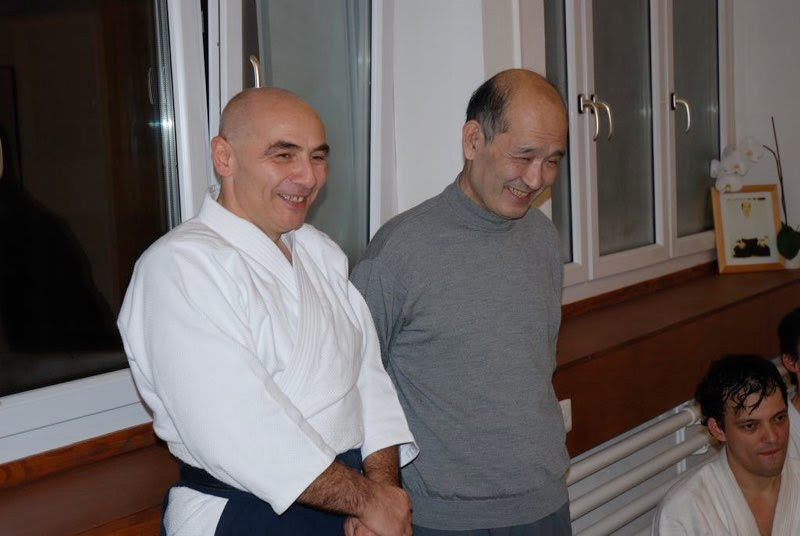
For me, he spoke the truth. It’s really hard to explain. He didn’t bother with finding anything special. He sought the essence. His speech was truthful. He never did anything spectacular just for the show. That’s the real Aikido for me. Things done for show are suspicious.
Did you join Ikeda Sensei’s dojo, or did you meet him just at seminars?
At that time, he didn’t yet have his own dojo in Switzerland. He lived in Bern and occasionally led seminars. We would come to see him regularly. He founded his dojo later, in Zurich. Since then, I visited him more often.
Did you move to Zurich so you could practice aikido under Ikeda Sensei?
By that time, I already had my own dojo in Basel (Aikido Schule Basel). That’s why I regularly went to Zurich by train. The journey took between 45 and 50 minutes. I came to see him two times per week, on Wednesdays and Fridays. Friday trainings were special, Ikeda often had visitors. That was always very nice and useful.
How long did it take before you became his uke?
I think it was around the year 1990 in Milano. That’s when I was his uke for the first time. It was truly unbelievable. The training hall was absolutely full. There must have been around 5000 people. When we started training, the crowd went completely silent. Why? Because people watched Ikeda Sensei and his movements, the expression of truth. I was lucky I got the chance to be his uke, because I could understand the essence of his techniques.
Did Ikeda Sensei have his personal ukes?
He would occasionally choose Daniel Vetter and Francesco Marrella, usually one or the other. Of course, he practised with others as well. When he was tired, he chose me, and we practised together until the very end. During a three-hour training session, I was often his uke for about one to two hours.
What were your responsibilities as the personal uke of Ikeda Sensei when he was abroad? What did you have to take care of?
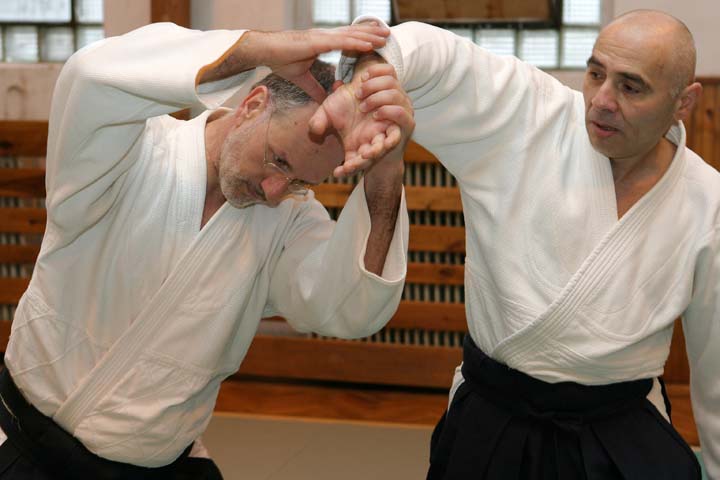
It was always necessary to pay attention to Sensei’s needs, to the people and the place we currently visited. Whenever Ikeda Sensei needed something, I had to sense it without him telling me. That’s how the Japanese people behave. For example, he was supposed to go to the train station. Well, he asked me, “Michele, are you going to the train station?” It was my job to figure out that he wanted to go there.
There are rumours that you asked Ikeda Sensei for a fifth dan examination.
Yes, that is true. But Sensei said it wasn’t possible. Until then, there were exams only to the third dan in Switzerland. Ikeda Sensei told me, “Fourth dan, that’s still okay.” You see, I was also the first person to take the fourth dan exam. Sensei Ikeda prepared a special list just for the fourth dan. From that time on, because of me, aikidokas in Switzerland and other countries had to take an exam for the fourth dan.
Sensei, did you stay in touch with Ikeda Sensei after he returned to Japan?
You mean at the very end?
Yes, at the very end.
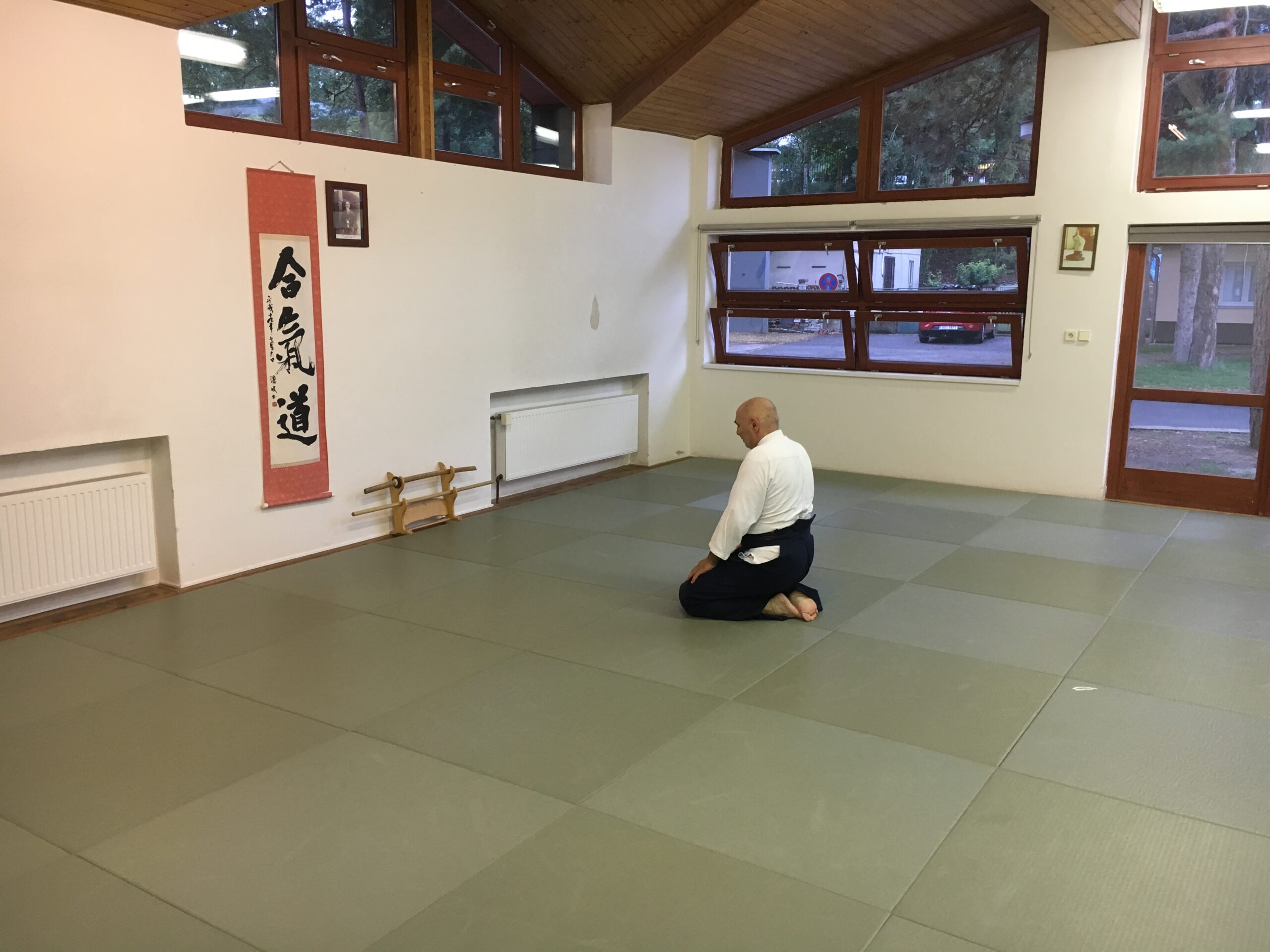
Yes. Sensei Ikeda had a dojo in Japan (Aikido Dojo Meishinkai). The first time we went to Japan, he led a training for the advanced there. There were holders of fifth, sixth, and seventh dans. I only had a third dan at the time, but I had to explain Sensei’s aikido to others. When Ikeda Sensei returned to Japan at the end of his life, he returned to this dojo. Before that, Kamei Sensei had been running his dojo, leading training sessions and taking care of it. So Ikeda Sensei returned to his dojo to Kamei Sensei.
Did you visit Ikeda Sensei in Japan afterwards?
Yes, I visited him several times. At first, he was at the clinic for some time. Then he started leading some of the trainings in his dojo again. It was in Iruma, and whenever I was in Japan, I went to see him. Whenever I was there, the training was split between Ikeda Sensei, Kamei Sensei and me. When the training was led by Ikeda Sensei, I was the main uke.
Why do you think Ikeda Sensei assigned hojo to aikido?
There are many parallels. Hojo is a form that helps structure the body for aikido. Of course, there is the physical aspect, breathing, and there is also the spiritual aspect. It is not a fight. The whole of hojo is practised so that both partners find the right distance and have the right rhythm together. Hojo was the best way to explain these things to people who practised aikido. There was no didactic system in Switzerland before Sensei Ikeda made one. There were many teachers, but everyone taught a little differently, and so the people went here and there. Everyone practised in their own way, with small differences.
And Genkikai? What is the purpose of Genkikai in aikido?
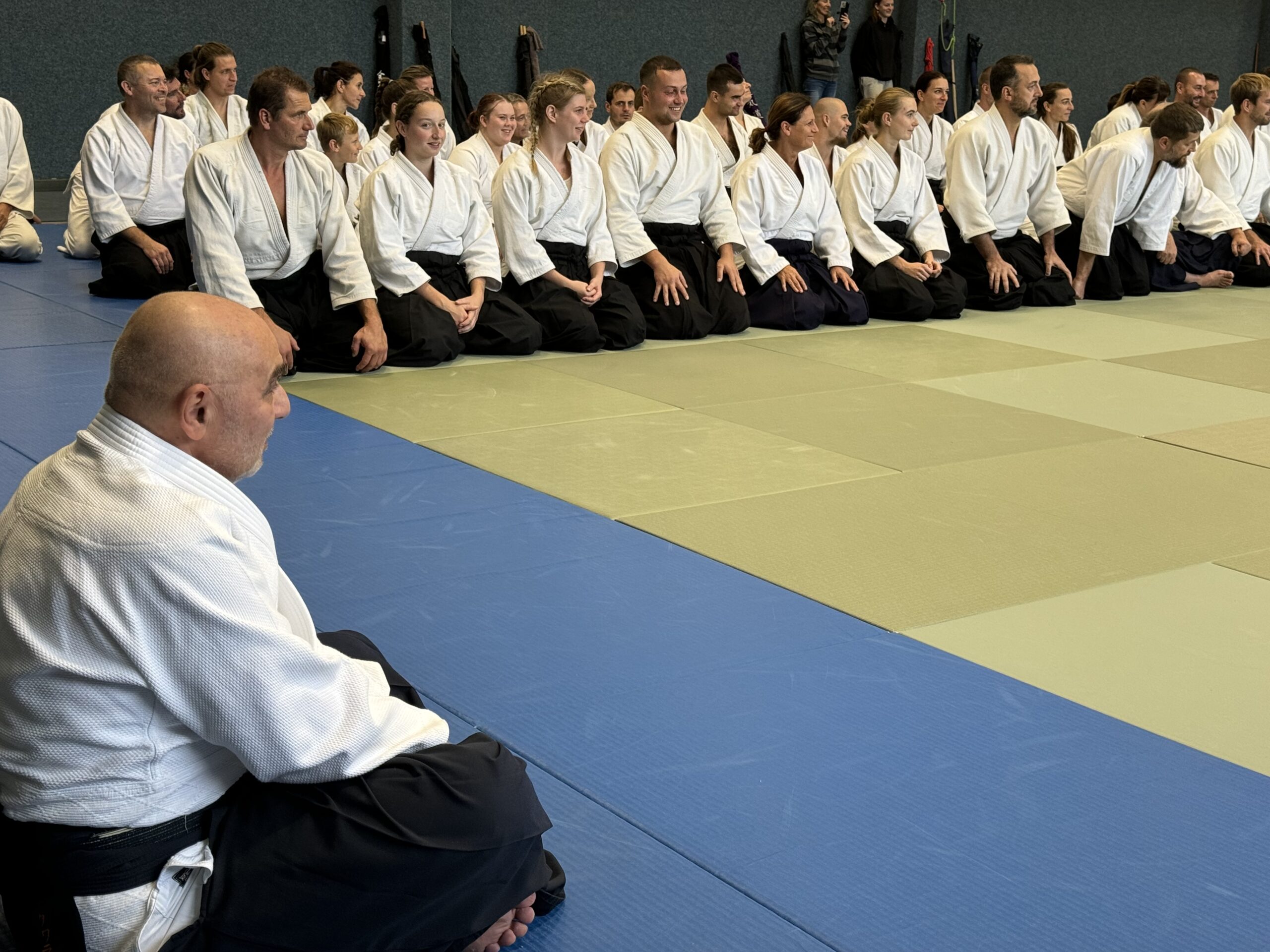
Genkikai was created by Sensei Ikeda. It is a combination of two teachings. One of them is Katsugen by Noguchi Sensei. It is important to understand that Sensei Ikeda practised aikido and hojo. Both of these disciplines are very exhausting. It is extremely demanding on the body. Genkikai was the thing that put the body in place. It includes Katsugen Undo exercises, where a person lets their body do what it wants. This is also an opportunity for students to find gentleness and fluidity within themselves, an opportunity to be relaxed. I can’t talk about it that much myself, but it’s a huge thing. The quality hidden inside is great.
Sensei, do you know whether Yodo-ho exercises come from Seitai by Haruchika Noguchi Sensei or from Nishi Shiki by Katsuzo Nishi Sensei?
Ikeda Sensei didn’t say. He didn’t tell us that what we were doing came from here or there. He said we were doing Genkikai, and that was all. In Yodo-ho, Europeans move like this (Sensei demonstrates the Yodo-ho movement, but he does it quickly and awkwardly), but the Japanese practice it like this (Sensei demonstrates the smooth Yodo-ho movement). The Japanese move very pleasantly, smoothly and gently. Here in Europe, or in the West in general, this exercise is often misinterpreted. When people practice it here, they move their hips a lot and put too much force into it. In fact, the essence of the exercise is moving the centre while not actually moving it.
Sensei, could you please say something about kototama and its role in aikido?
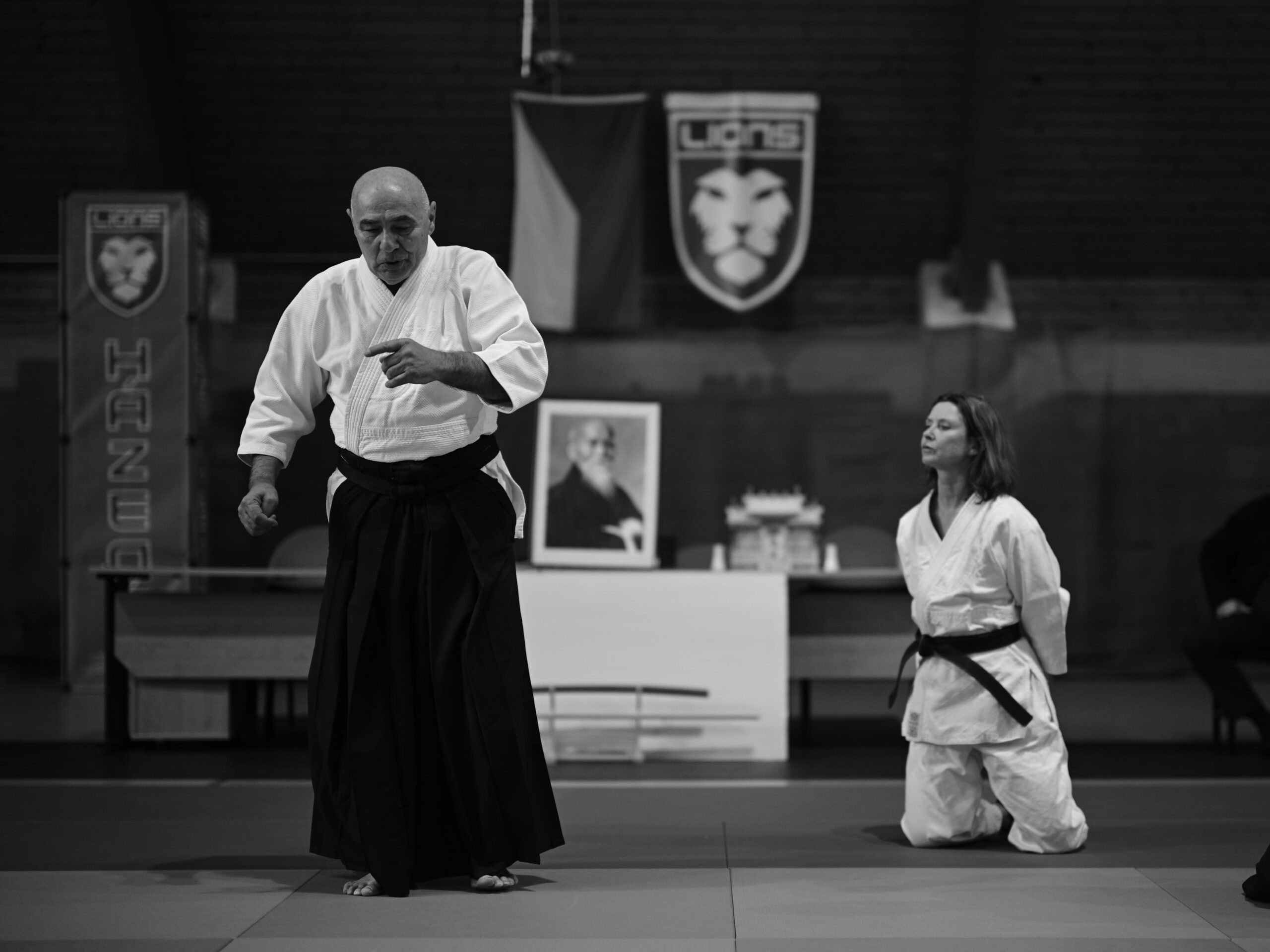
Kotodama are primordial sounds. These sounds come naturally when we make certain movements. It is said that kotodama was created by the gods. It is difficult for me to describe. I know kotodama from practice, but it has a much deeper meaning than I can express. All I can say is that they are the original sounds of creation. If we have something blocked in our bodies, we can use these sounds to unblock it, provided that we know how to work with them.
Do you ever practice, like O-sensei, a series of sounds A, O, U, E, I or TA, KA, A, MA, HA, RA?
Could you repeat that again?
O-sensei sometimes made these sounds as a way of misogi. I wonder if you ever do this kind of exercise?
I don’t usually do this exercise, but when I had my (brain) stroke, especially in the beginning when it happened, I untied my body like you untie a knot. When I had to do something, I got breathless. It was very emotional for me. I managed to untie myself with sound, but without any noise. It was all inside myself. If someone were to look at it from a Western perspective, they would say I wasn’t doing anything, but I was doing it inside of me. It was one of the exercises that helped me heal my body.
Did your medical condition help you understand something new in aikido?
At that moment, I understood that we are only here for 70-80 years. I was really close to death, and to be honest, I didn’t even want to come back. The world is full of conflict. When I was on the “other side”, It didn’t feel that bad. I didn’t feel any conflict. I think we are here to find solutions to the problems in our lives. We are not here to become rich or anything like that. We try to adorn ourselves with many embellishments, but they are useless because in the end, we have to leave
everything behind anyway.
Is there a way to work with the heart (not in the sense of an organ, but in a spiritual sense) when training aikido?
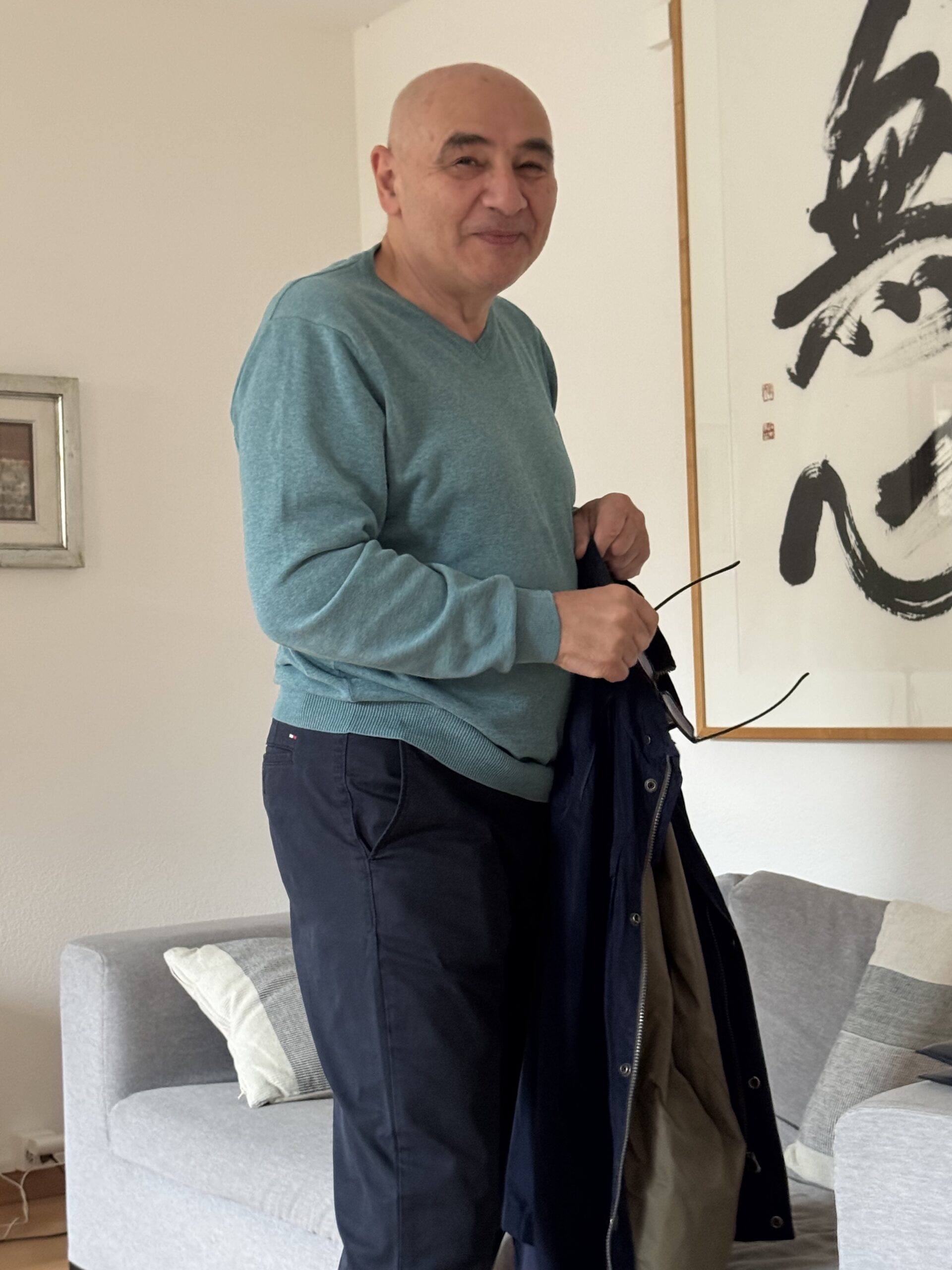
We always have to work with the heart, even just by moving our bodies from side to side, from top to bottom, during training. We can’t move just our heads. We must always turn the centre and use our shoulder blades as well. How many people walk bent over like this, and how do their backs look like? The heart is very important. The heart chakra is a very important energy centre. We must use it. You ask me how to use it, yet we had an entire training session about it during our seminar. First, there is the physical level. The process is always the same: first, it is the physical body, then it is the mental and thinking area, and lastly, it is the spiritual area. These three stages are always involved. Perhaps it is difficult to understand for someone who is just starting aikido or is not old enough, but our goal here on earth is our spiritual path, and this spirituality must be realised here, in this reality where we currently are. It is necessary to become conscious in ever moment. Practising aikido leads us to become introspective among many people, to come to ourselves. I have nothing more to say about this. Of course, it can then be broken down into all sorts of things.
Some aikido systems do not practice with weapons. Do you think buki-waza is an essential, necessary part of aikido?
O-sensei said that aikido is complete, whole. Nothing else is needed, and we always have a weapon in our hands, even if it is not visible. All the movements we do in aikido are the same with or without a weapon. However, I think that sometimes practising with weapons helps people realise how these movements, or something from aikido, such as Ma-Ai (ideal distance), should look. It’s different depending on whether your hands are free or you’re holding a sword or a jo.
For example, when we practice with weapons here at the seminar, and I look at the students, I see that many don’t know how to keep the distance. Everyone quickly learns the form, but distance… The right distance is something very hard to grasp, because it’s sometimes close and sometimes far. It is constantly changing.
For example, in music, there is do, re, mi, fa, sol, la, si, do. In music, we say that we have notes. But that is not music. The real music is the distance between one note and another. It is the same in martial arts. Music can explain martial arts, and martial arts can explain music. It is irreplaceable and can become something incredibly beautiful. Once, Halka (Halka Baláčková, who is also translating this interview) and I were at a concert at the Prague Castle. We were listening to a singer of Roma origin, Věra Bílá. Before one songn, she told us, “I’m going to sing now, and when I sing one note, I warn you in advance, some of you may cry.” And that’s how it was. We were all happy inside during the song, and when she sang the passage, it touched all of our hearts. People really cried. That moment explained to me what aikido is. We talked about kotodama, right…
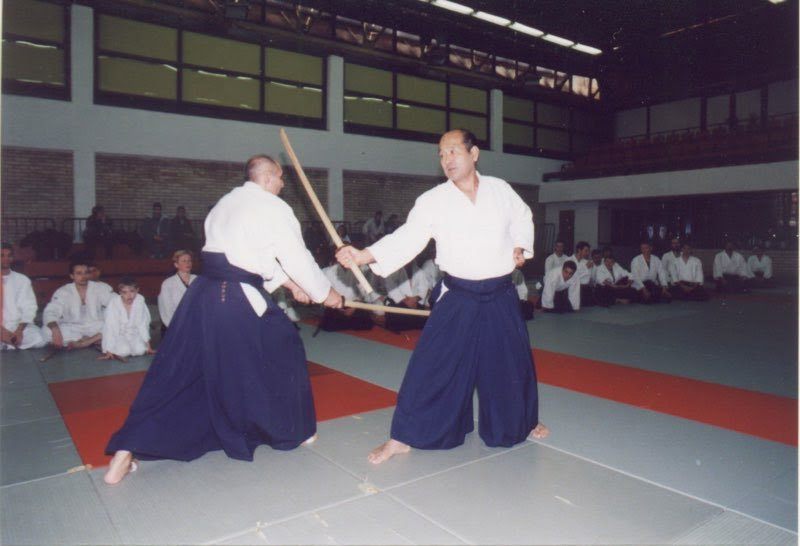
Sensei, do you ever practice Kokyu Soren?
I don’t practice it anymore, but I used to do it for about twenty, maybe thirty years. I no longer practice some things physically but rather internally. When I was young, I practised many things physically and pushed my body to do them. Kokyu Soren is an exercise that I no longer practice in a physical way, but subconsciously. If you know how to use your body correctly, it doesn’t matter whether you practice physically or not. There is a lot to it. Physical exercise is good for people who don’t know how to do it yet. But when you already know something thoroughly and can do it well, you don’t always have to practice it physically. For example, you can sit somewhere and just tap your chest, or do something that Kokyu Soren involves. That’s enough.
How would you describe the exercises of Dai En Kokyu Ho, such as Yo no Te Kokyu, In no Te Kokyu, Su no Kokyu, and so on? Why are these exercises practised in their particular way, and what is their purpose?
When we practice, it is so that we can become one, so that we can unite. For example, when we do Torifune in training, everyone shouts. I wait for the moment when all the sounds unite, connect and become one, and at that moment I stop the exercise. This is necessary for Torifune. In Torifune, we use sound, so it is easier to recognise this unification. Again, breathing exercises have three phases. First, you need to learn them physically. You need to do it for a long time. Take it as some kind of medicine; it will become a part of your body. Then, you can stop doing it. However, when you feel the need to exercise, you should do it again. It’s not something you have to do for the rest of your life. Then you would be just doing one thing and not anything else. That would be a shame because there are so many things to discover on Earth.
I didn’t ask quite correctly. I mean, what is the essence of each individual exercise? Why Yo no Te Kokyu? Why Su no Kokyu, etc.?
Su no Kokyu makes the body calm. We do Yo no Te Kokyu so that we can become aware of our reach, of our boundaries. In no Te Kokyu helps us become aware of our inner sphere, our inner space. A UN no Kokyu makes it awhole. It puts a full stop at the end of the entire breathing cycle.
And Ki Musubi no Te Kokyu?
It serves to help a person discover breathing. It is a kind of counter-breathing. This style of breathing puts our body in a bit of trouble, but only until we realise that we are the ones who create it ourselves, as in life. If I inhale here (Sensei performs the first movement of Ki Musubi no Te Kokyu) and then exhale here (the second part of Ki Musubi…), a large movement would normally follow. However, I suddenly do it in a very confined space. When we do this often enough, we discover that our body can expand and enlarge. How would I best explain it? For example, my body: now I squeeze my chest. I want to breathe in, but I can’t. So I breathe in somewhere else, right? We have been taught that we can breathe here in the front, but suddenly we discover that we can also breathe somewhere else. Do you understand? We create pressure on the chest but open the shoulder blades at the back. Our body has many possibilities; we just have to discover them. We have to discover that our body is not actually limited. We have to understand that. Not in someone else, but in ourselves. In ourselves. That’s why, when we exercise, sometimes I say, “Go inside yourself!”
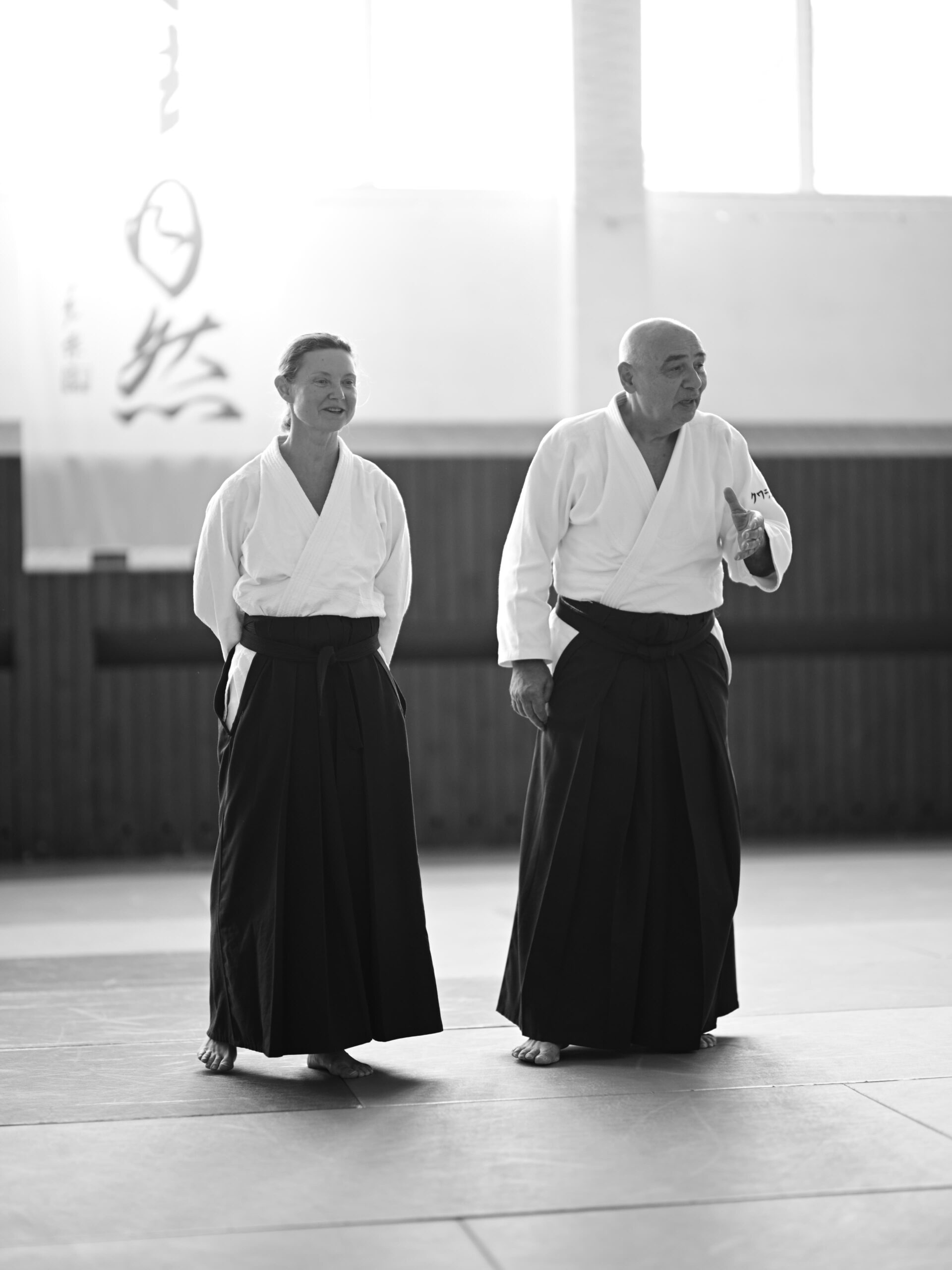
Today you also did an exercise from Qigong with us. What was the purpose of this exercise?
I incorporated it mainly for relaxation. At least people don’t think too much about the fact that it’s not an aikido movement. They can’t imagine what it actually is. When I put my hand back here (Sensei shows a movement from the exercise where one hand stretches down and makes a slight backward movement, and the other hand does the same, but above), I work with many parts of the body, especially the shoulder blades. I align one shoulder and then the other. Then I go to the other side. One is always up, and the other one is down. In Qigong, there is also an exercise where both shoulder blades are pulled together. Here, one is up, and one is as if inward. Here, it is the other way around. In this move, both are together (Sensei demonstrates the movement, stretching both arms down and making a slight backward movement). Maybe it’s qigong, maybe it’s a conscious breathing exercise. More important than the name is that we realise what we are actually doing.
Sensei, did you practice Qigong in depth?
Not in depth, but I am familiar with it. If I had studied Qigong in depth, I would have also taught it, and then I wouldn’t have enough time for aikido. Aikido includes it. It is interesting that the Japanese masters who came to Europe taught us and showed us much more than they did in Japan. They were here and had to find a way to change us, to help us see a world that was different from ours. There are many movements that Japanese people do completely naturally because they are a part of their culture. For example, certain body movements. They can help us here, but we have to learn them.
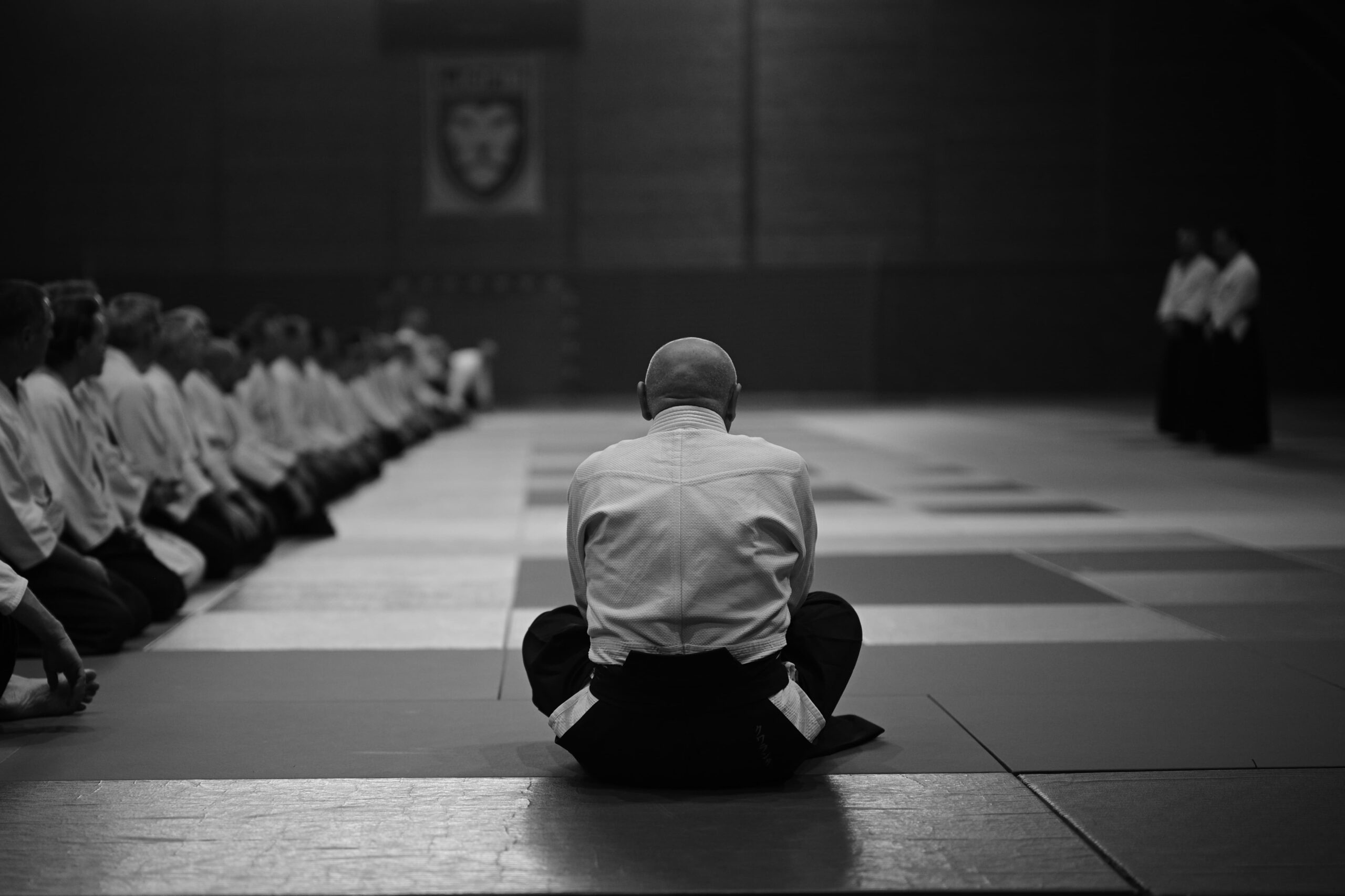
Have you ever used aikido in self-defense, in a combat situation?
Yes, I have. I had a second kyu when they attacked me. It was a kind of quarrel on the street, and I didn’t know many techniques. There were three of them, and I was alone. Suddenly, all three of them were on the ground. Maybe it was luck. I’ve always been quite strong. At that time, the techniques began to become a part of my body.
Do you have any funny, entertaining stories to finish with? Perhaps with Ikeda Sensei?
I can tell you one thing. Whenever we travelled with Sensei Ikeda, I always got the best room in the hotel without even asking for it at the reception desk. Ikeda Sensei always got a second-class room. There was always something wrong with his room, the lights not working, the water not running, or something like that. Sensei Ikeda would always come and say, “Could I see your room?” (laughter) And I would pack my bags and move, because it was clear that there would be an exchange. Now it’s happening to me! Whenever I go somewhere, someone else has a nicer room. I’m left with something shabby. I don’t know why this happens to me, it’s interesting.
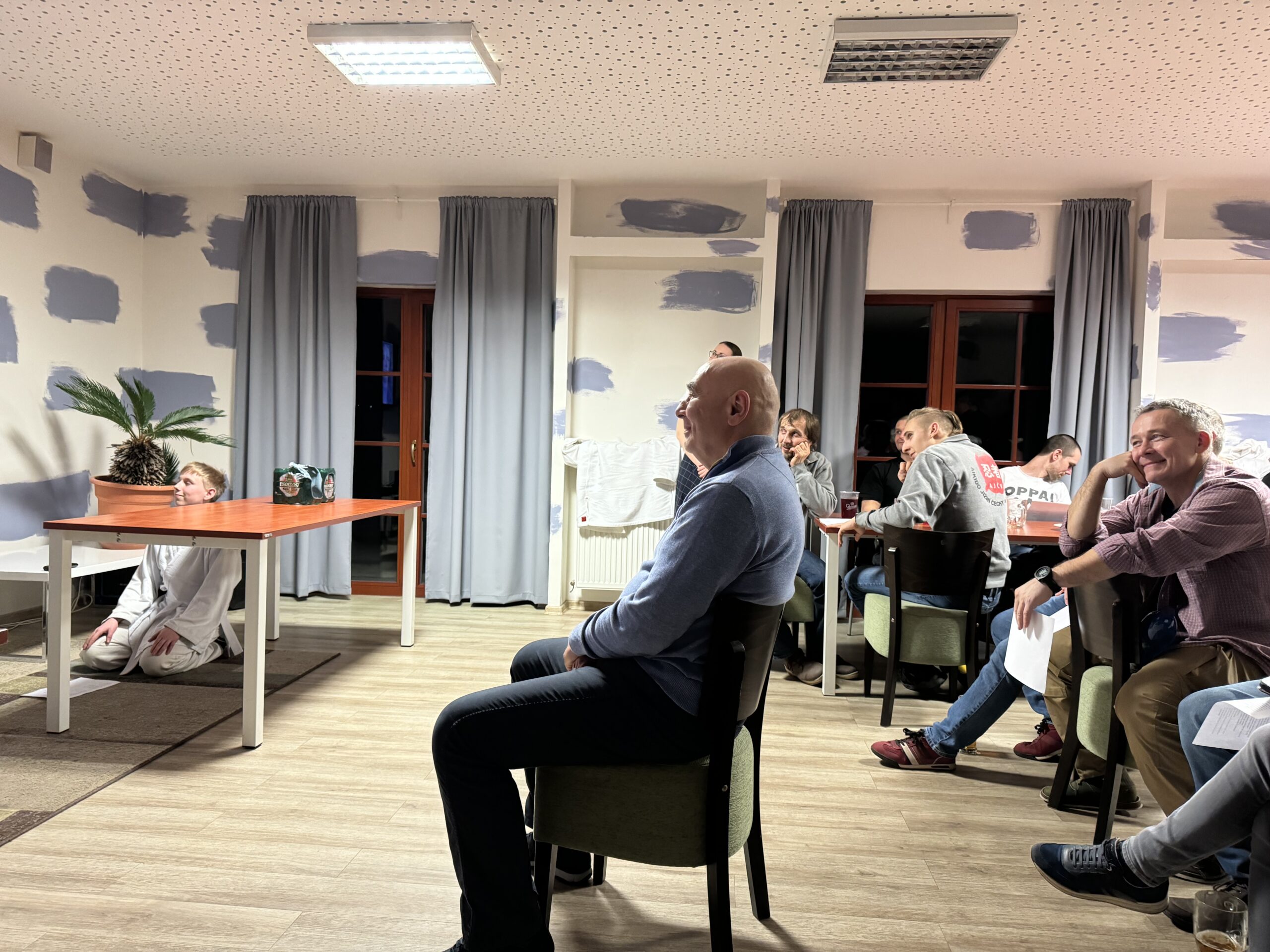
Sensei, would you like to say something in conclusion, some thought or a message?
I am in the last third of my life. I am 72 years old. I am happy that I can practice aikido and learn something new every day. I think I can say with a clear conscience that this is the most important thing in my life, to discover something new every day. You just need to be aware of those discoveries. We discover something new every day. Not just me, but all of us.
Thank you so much!